
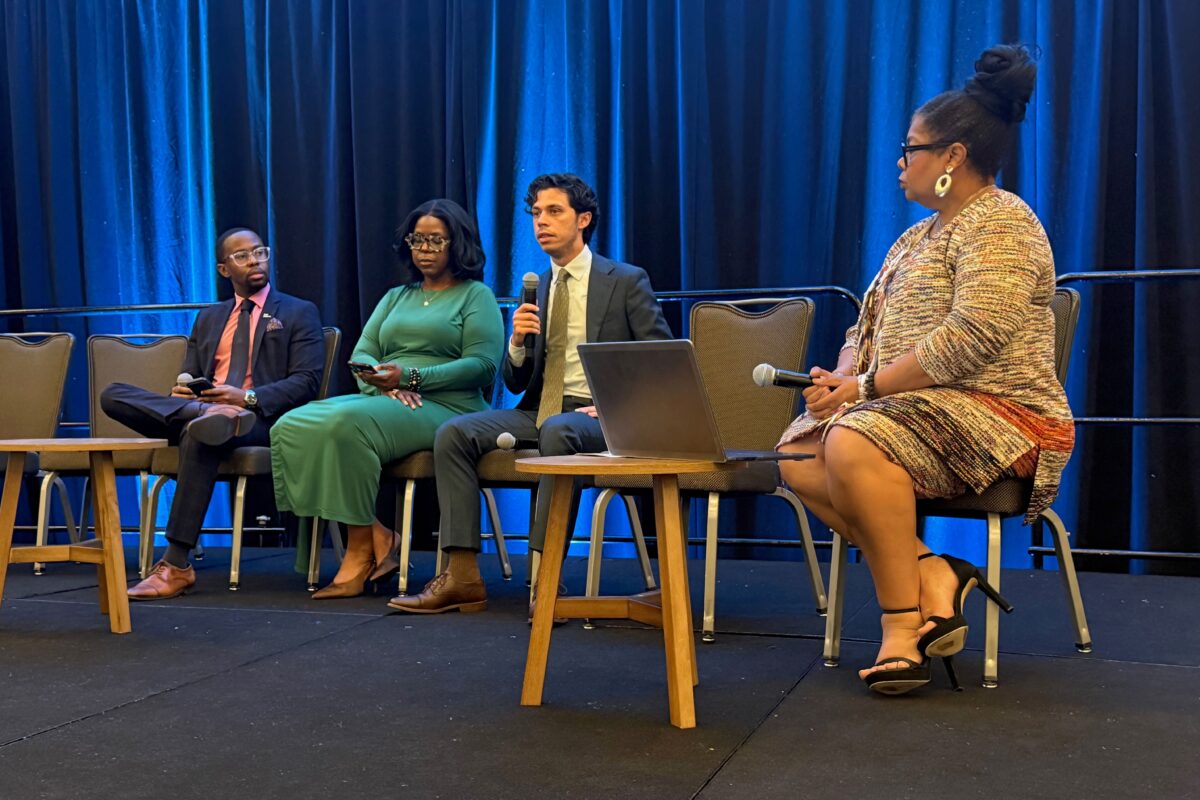
At The Congressional Black Caucus Conference, A Lynching Panel Confronted America’s Suspicious Black Hanging Deaths

Attorney Lee Merritt and the Rev. Jamal Bryant noticed a glaring omission from the agenda of the Congressional Black Caucus Foundation’s Annual Legislative Conference: not a single session addressed lynching.
So they organized their own last-minute panel.
Held at the Westin Washington, D.C., Hotel, the event examined both the history and the series of contemporary deaths that families and civil rights advocates fear may be modern-day lynchings but have not been investigated as such. Three panel discussions featured a range of experts, including civil rights attorneys, mental health professionals, and scientists.
The panelists explored how the deaths of Black people are frequently misclassified, how those classifications can derail investigations, and how the growing crisis of Black suicide complicates questions surrounding these suspicious deaths.
Merritt opened the program by inviting a group of students and recent graduates from his civil rights fellowship program to read the names of victims of racial violence.
“I’ve learned that sometimes we often too quickly dehumanize the situation,” Merritt said. “We make slogans and hashtags. These are people. We have to start with their names.”
Rev. Bryant described the current moment as “a crisis emergency,” adding that “the same generation who witnessed Emmett Till is now having to see Nolan Wells.”
Wells was an 18-year-old college football player whose body was recovered on the shoreline of Horn Island in Mississippi on July 6 after a boating trip with white friends. Law enforcement officials immediately reported that they found no evidence of foul play. An independent autopsy performed in Washington, D.C., found that the cause and manner of death could not be determined, sparking calls for greater transparency and further investigation.
Rev. Bryant also sought to counter misinformation surrounding mental health in the Black community, particularly the false belief that Black people do not hang themselves as a form of suicide. That is why he saw the need to include mental health professionals in the panel conversation alongside civil rights activists and forensic experts.
During the first panel, Tunisha Brown, founder and publisher of IMPACT Magazine, offered a modern definition of lynching:
“A discriminatory killing committed in the late 20th or early 21st century by more than one person, carried out for an alleged offense with or without legal trial or due process, and motivated by race, gender, or sexuality.”
That expanded definition recognizes that gender-based and anti-trans murders emerge from the same culture of extrajudicial violence that fueled racial terror during the Jim Crow era.
The panel’s other speakers, civil rights and defense attorney Blerim Elmazi and public health expert Dr. Michael Forde, stressed the importance of historical context when investigating the death of a Black person found hanging. When suicide becomes the default assumption rather than one possibility among several, that assumption shapes how authorities treat the scene from the outset.
Crime scenes are not secured. DNA and trace evidence can degrade. Decomposition can make it more difficult for autopsies to identify trauma. Families are often forced to conduct their own investigations because authorities fail to provide transparency. Civil litigation may become their only avenue for justice, even though monetary damages cannot substitute for criminal accountability.
During the second panel discussion, Natasha Pratt-Harris, director of the Applied Sociology and Social Justice Ph.D. program at Morgan State University, discussed the racial disparities shaping how Black people’s deaths are investigated.
“It’s about race,” Pratt-Harris said. “Dr. Raymond Winbush, a noted race-based theorist, talks about the idea that race is in the center of it all. Everything is in racism. So when we talk about the ‘Strange Fruit,’ when we talk about the assessment of a police-involved death, and there’s questions about: Did this person die because of the beating by a police officer, or was it his heart that just so happened to stop when he was being beaten?”
Pratt-Harris noted that when it involves Black people, the outcome is driven by race above all else.
Dr. Roger Mitchell, a board-certified forensic pathologist, emphasized the need for justice in forensic pathology and more equitable access to the field, including greater representation among the professionals responsible for examining the deaths of Black people.
“Forensic medicine is medicine like any other medicine, and if we don’t have people performing that kind of medicine, they won’t get equity in the medicine,” Mitchell said.
Civil rights and criminal defense trial attorney Sean Daredia noted that there have been no prosecutions since the passage of the Emmett Till Anti-Lynching Act in 2022. That does not mean no lynchings have occurred since then, he said. It may reflect failures to properly investigate potential cases.
The final panel examined mental health in the Black community and featured experts Dr. Michael Lindsey, Dr. Alfiee M. Breland-Noble, and Dr. Isha Metzger. The panelists warned that suicide rates among Black men and youth are rising while mental health resources remain underfunded, inaccessible, and burdened by stigma.

Lindsey explained that two things can be true at once: Black communities can face a genuine mental health crisis, and authorities can still be wrong to rush toward suicide as the explanation for a suspicious death.
Metzger discussed how the legacy of racial violence continues to affect Black mental health through racial trauma and has been described as post-traumatic slave syndrome.
Lindsey also noted that suicides tend to occur in private rather than public settings. That distinction, he said, is significant when a Black person is found hanging in public spaces, particularly outdoors from a tree.
When an audience member asked about available resources, Breland-Noble, known as “Dr. Alfiee,” recommended her book, Rise and Thrive, for young people learning how to manage mental health challenges. She also directed attendees to AAKOMA.org, which provides free mental health tools and a database of therapists who work with people of color.
Metzger shared that her website, DrIshaMetzger.com, offers racial healing care packages and a downloadable racial trauma guide.
The panelists also called for legislation that would make mental health services more affordable and accessible in marginalized communities. They advocated for the inclusion of racial trauma in the Diagnostic and Statistical Manual of Mental Disorders, or DSM, which could help Black patients receive appropriate diagnoses and secure insurance coverage for treatment.
Ultimately, the event confronted three overlapping crises: the continuing threat of modern-day lynching, systemic failures in the investigation of Black deaths, and the mounting toll of racial trauma and suicide in Black communities.
The absence of these issues from the conference agenda was precisely why Merritt and Bryant believed the conversation had to happen.
Madison Maynard is a senior broadcast journalism major at Howard University. She hosts Time to Talk Politics on WHBC 96.3 HD3 and anchors Spotlight Network’s Herd It All, where she is building her career as an aspiring political reporter. You can follow her on Instagram @44wethepeople.
SEE ALSO:
Protesters In DC Sound Off During Nationwide No Kings Demonstration
An HBCU Student Goes To Class And Then The Gun Range: Here’s Why