
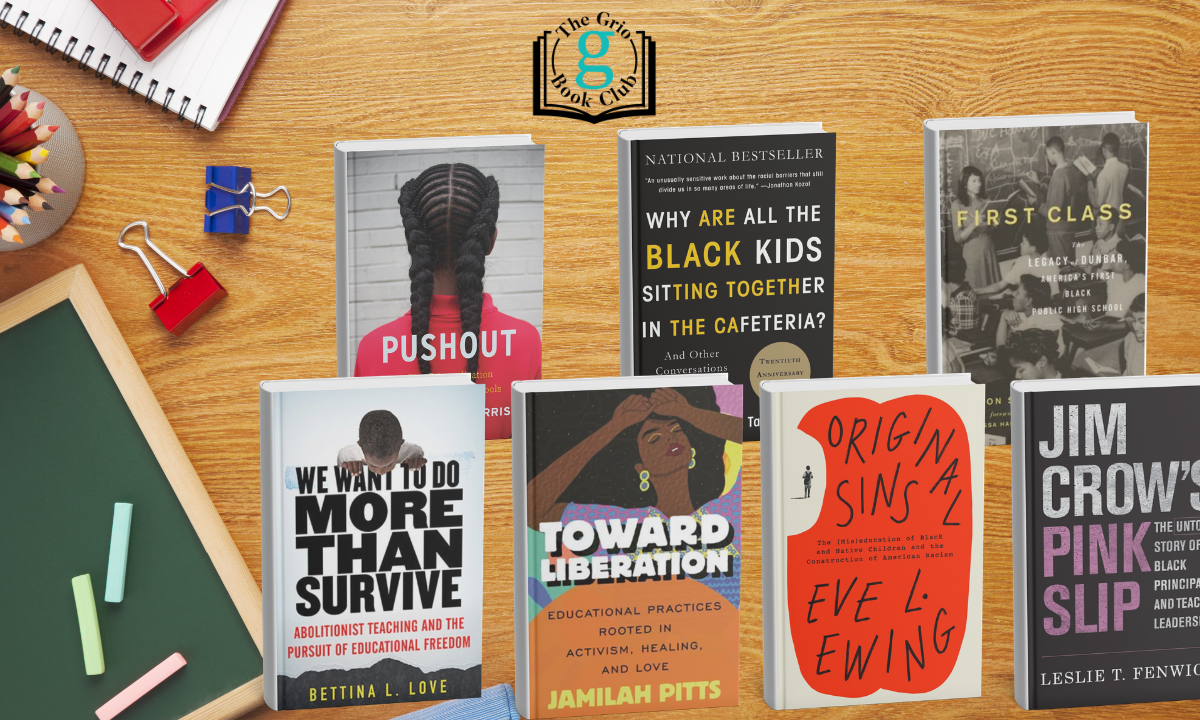
10 Books by Black authors that explore what it means to be Black in the classroom

As social media debates what Black children need from schools, these books examine the history and systems behind those conversations.
Black children, education and systems are at the forefront of group chat discussions and timeline think pieces this week, after Nikole Hannah-Jones revealed the tension she experienced in her own home when it came to her child’s education. Since publishing “In Fighting for Every Black Child, Did I Betray My Own?” in the New York Times Magazine, Jones’ candid account of navigating the New York City public school system has sparked waves of discourse across social media as users share their thoughts and reactions to the Pulitzer Prize winner’s personal essay.
However, as debates about Black children’s experiences in classrooms and the seemingly impossible decisions Black parents face regarding their children’s education continue, here are 10 books by Black authors that spotlight the unique experience of being Black in the classroom.
Original Sins: The (Mis)education of Black and Native Children and the Construction of American Racism by Eve L. Ewing

In “Original Sins,” Ewing asks why American schools fail Black and Native children, and offers an unsettling answer: they may be doing exactly what they were built to do. She argues that, rather than acting as the great equalizer, America’s classrooms were designed to maintain the nation’s inequalities. She shows how schools were set up to spread the idea of white intellectual superiority, to “civilize” Native students, and to prepare Black students for menial labor. She argues that these patterns continue today in a curriculum that downplays the horrors of American history and encourages
Fugitive Pedagogy: Carter G. Woodson and the Art of Black Teaching by Jarvis R. Givens

Grounding itself with the subversive roots of Black education, Givens’ work explores the “fugitive pedagogy” tradition that African Americans have created through the years of seeking education in secret, often against law and custom and under threat of violence. Centering Carter G. Woodson’s work and the impact Black teachers had on his life, the book follows how teachers, students, families, and communities used Woodson’s materials and methods to combat the “mis-education of the Negro” by helping teachers and students to see themselves and their mission as set apart from an anti-Black world.
We Want To Do More Than Survive: Abolitionist Teaching and the Pursuit of Educational Freedom by Bettina L. Love

Drawing on her years of teaching and research in urban schools, Love argues that the U.S. education system is sustained by, and profits from, the suffering of children of color. Rather than fix a broken system, she says, reformers offer survival tactics such as test-taking skills, acronyms, grit labs, and character education. She calls this the “educational survival complex.” To move toward real educational freedom, she calls on teachers, parents, and community leaders to approach education with the imagination, boldness, and urgency of abolitionists.
Pushout: The Criminalization of Black Girls in Schools by Monique W. Morris

15-year-old Diamond stopped going to school after she was expelled for lashing out at classmates who kept harassing her. What no staff member had noticed was that she was being trafficked for sex. She was later arrested and sent to detention for violating a court order to attend school. The data behind stories like hers is stark: Black girls make up 16 percent of female students but nearly half of all girls arrested at school. Over four years, Morris documented Black girls across the country whose lives are misunderstood and harshly judged by teachers, administrators, and the justice system.
Why Are All the Black Kids Sitting Together in the Cafeteria? by Beverly Daniel Tatum

In any racially mixed high school, Black, white, and Latino students cluster in their own groups. Tatum asks whether this self-segregation is a problem to fix or a way of coping. A leading expert on the psychology of racism, she argues that frank talk about racial identity is essential if we want real communication across racial and ethnic lines.
Jim Crow’s Pink Slip by Leslie T. Fenwick

Fenwick examines a little-known fallout from Brown v. Board of Education: the systematic dismissal of Black educators from public schools. The 1954 decision ended legal school segregation, but as congressional testimony shows, it also ended the careers of a generation of highly qualified Black teachers and principals. In the decades that followed, Black schools across the Deep South and border states were illegally closed and Black educators were pushed out en masse. Fenwick connects that history to today’s problems, including the underrepresentation of Black teachers and principals, salary cuts, teacher shortages, and systemic inequality, while offering policy fixes.
Other People’s Children: Cultural Conflict in the Classroom by Lisa Delpit

In “Other People’s Children” Delpit argues that teachers must act as effective “cultural transmitters” in classrooms where prejudice, stereotypes, and assumptions often lead to poor teaching. She argues that many academic problems blamed on children of color actually come from miscommunication, as mostly white teachers and “other people’s children” contend with imbalances of power in the system.
Toward Liberation: Educational Practices Rooted in Activism, Healing, and Love by Jamilah Pitts

Pitts offers a practical guide for frontline educators to confront systemic racial oppression, repair harm, and build safe, inclusive classrooms. It draws on her own experience as a young Black girl, a Black student, a teacher, a former school leader, and a consultant to schools nationwide. It includes examples and student writing from her classroom, reflection questions for equity work, charts mapping how harm shows up, activities for students, and self-care strategies for teachers, especially Black women educators.
Sing a Rhythm, Dance a Blues by Monique Morris

In this follow-up to “Pushout,” Morris draws on the spirit of the blues to lay out a healing, empowering way of teaching Black and Brown girls. The book imagines what schools could look like if they put the thriving of Black and Brown girls at the center. It combines research with interviews, case studies, and testimony from people who work successfully with girls of color. The reporting travels from Oakland to Ohio and from New York to Iowa City, sharing how educators can partner with students and help girls find value and joy in learning
First Class: The Legacy of Dunbar, America’s First Black Public High School by Alison Stewart

In the first half of the 20th century, Washington, D.C.’s Dunbar High was an academically elite public school, even though it was segregated by law and depended on racist congressmen who controlled its funding. It drew a remarkable faculty. One of the school’s early principal was Harvard’s first Black graduate, nearly all its teachers held graduate degrees, and several had PhDs, all under Jim Crow. Stewart pairs that history with a frank look at urban public education today, opening a conversation about what makes a public school succeed.