
‘They Aren’t Safe’: Concern for Justice Amy Coney Barrett’s Two Black Adopted Children Spread Online After Voting Rights Decision
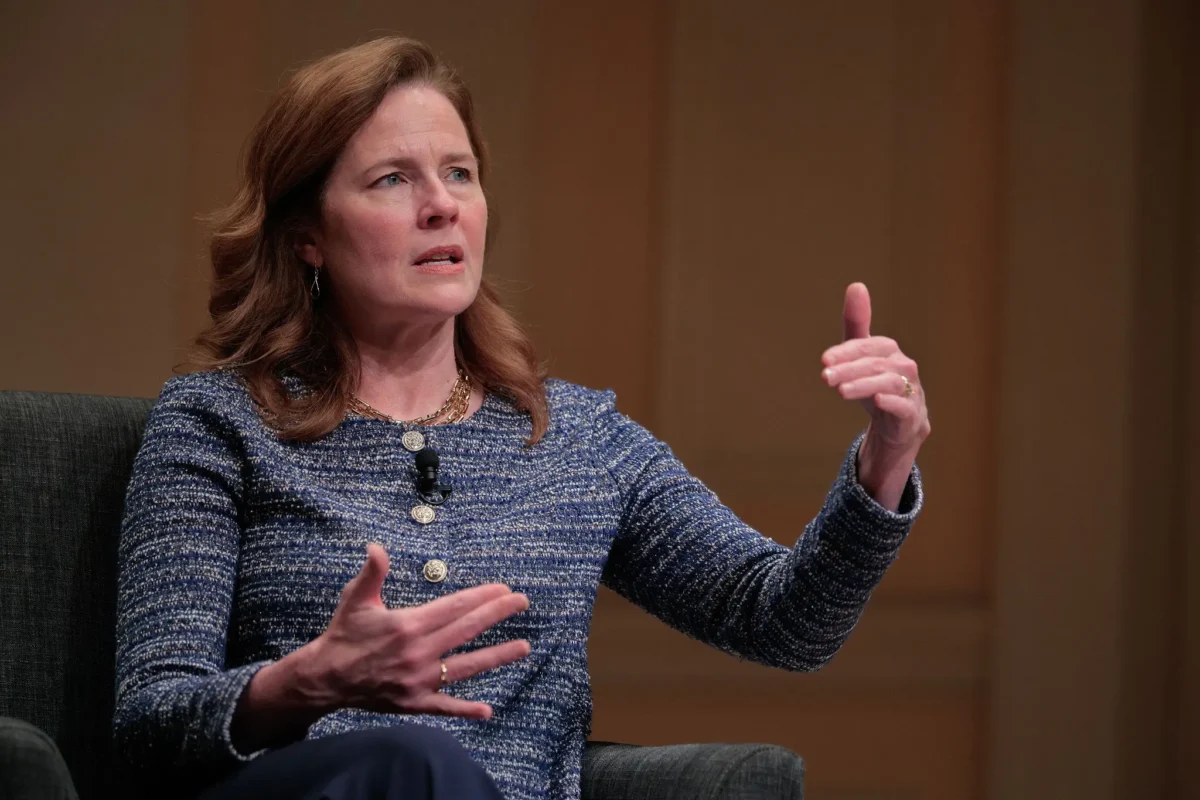
Supreme Court Justice Amy Coney Barrett joined the conservative majority April 29 in striking down a key provision of the Voting Rights Act, a decision that is now colliding with a deeply personal part of her public identity.
As a photo of Barrett’s family circulates online, showing her and her husband with their seven children, including two Black children adopted from Haiti, the image has become a new flashpoint, testing the principle-over-politics persona she has long projected.
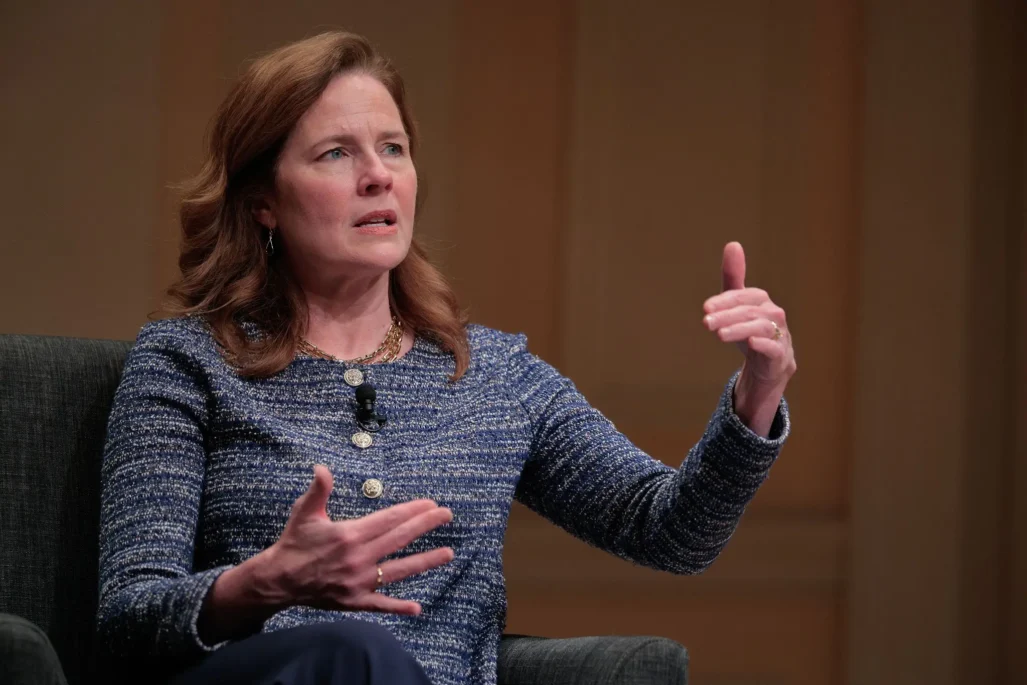
For some critics, the contradiction highlights what they see as a disconnect between her role in weakening a landmark civil rights law and the reality inside her own home.
The backlash centers on the court’s April 29 decision in Louisiana v. Callais, where Barrett sided with a 6-3 ruling to strike down a congressional map that created a second majority-Black district, significantly narrowing how Section 2 of the Voting Rights Act can be used to challenge racial discrimination in voting.
The ruling, critics say, raises the bar so high that proving discrimination becomes far more difficult, with potential ripple effects for minority representation nationwide, a reality that has fueled sharp reactions now spilling beyond legal arguments and into personal scrutiny of the justices themselves.
Online, Barrett’s family photo has taken on a life of its own, with users dissecting not just the ruling but the image’s composition. Some reactions veer into deeply personal territory, reflecting anger over what the decision could mean for Black voters.
“How do I alert Child Protective Services that the adult female in this photo believes that the two Black people also in this photo does not have the right to vote!?!” one post declared.
Another added, “Those black kids are nothing but props for them. She’ll use them to say see I’m not racist.”
Others focused on the visual arrangement in the photo, suggesting it would be easy to crop out the Black children, given where they were standing.
“It is telling that the black kids are on the outside and not being visibly touched by anyone,” one user wrote. Another echoed that sentiment: “Exactly that’s a red flag for me too. Why are they on the outside? Somebody better check on these children.”
A separate post took a broader view, stating, “I fear for Black children adopted into white families. They aren’t safe.”
The emotionally-charged reaction is rooted in a decision with far-reaching legal consequences. The case stems from Louisiana’s redistricting battle following the 2020 census. Although roughly one-third of the state’s population is Black, lawmakers initially drew a map with just one majority-Black district out of six. A group of Black voters challenged that map under Section 2 of the Voting Rights Act, which prohibits voting practices that discriminate based on race.
A federal district court agreed the map likely violated the law and ordered the state to redraw it. Louisiana responded by creating a second majority-Black district, a move that briefly expanded representation and led to the election of Rep. Cleo Fields. But that revised map was soon challenged by a group of non-Black voters, who argued it relied too heavily on race in violation of the Constitution’s Equal Protection Clause.
That challenge ultimately reached the Supreme Court, where the conservative majority signaled skepticism about race-based remedies. During arguments, some justices questioned whether complying with the Voting Rights Act could justify drawing districts with race as a primary factor.
Barrett herself raised concerns about whether such compliance constitutes a “compelling interest” when the underlying violation has not been definitively proven.
The court’s final decision sided with the challengers, concluding that the map amounted to unconstitutional racial gerrymandering. While the ruling did not eliminate Section 2 outright, it sharply limited how it can be applied, particularly in cases involving redistricting.
Not all members of the conservative bloc stopped there. Justice Clarence Thomas, who is Black himself, joined by Justice Neil Gorsuch, went further in a concurring opinion, arguing that Section 2 itself should be struck down entirely. That position reflects a broader push among some conservatives to adopt a strictly “colorblind” interpretation of the Constitution, rejecting policies that explicitly consider race, even as a remedy for past discrimination.
Liberal justices warned that the decision could gut one of the most effective tools for combating racial discrimination in voting. In dissent, the minority argued the new standard makes it nearly impossible to prove violations, effectively weakening protections that have shaped political representation for decades.
The Voting Rights Act, signed into law in 1965 after the civil rights movement exposed widespread voter suppression, has long been considered a cornerstone of American democracy. Over time, however, the Supreme Court has chipped away at its provisions, including a 2013 decision that removed federal oversight of voting changes in certain states. Critics see the latest ruling as part of that same trajectory.
Barrett’s role in the decision has drawn particular attention because of her personal story. She and her husband adopted two children from Haiti, a choice she has spoken about publicly, describing the conditions at the orphanage and the challenges her children faced early in life, according to The New York Times. That background has made her vote in this case more controversial.
Supporters of the ruling argue that it reinforces constitutional limits and prevents race from being used as a dominant factor in government decisions. Critics counter that it ignores the realities of discrimination and undermines efforts to ensure fair representation.
The online reaction, though often harsh, reflects a broader debate now playing out across the country, about how far the law should go in addressing inequality, and what happens when those legal principles collide with personal narratives that many Americans find difficult to reconcile.