
‘Nobody’s Hands are Clean’: Raphael Warnock Accuses Republicans of ‘Rabid and Shameless’ Scheme to Silence Black Voters Before Midterms, Challenges Dems to Fight Back
On April 29, the day the Supreme Court announced its decision in Louisiana v. Callais to gut Section 2 of the Voting Rights Act of 1965, a “deeply disappointed” Sen. Raphael Warnock held a press conference lamenting the huge blow to “the crown jewel of the civil rights movement,” calling it “a slap in the face of those who worked so hard to push this country closer to its ideals.”
Noting that the Congressional Black Caucus has been steadily shrinking, he said, “They are changing the diverse face of our Congress in one fell swoop.”
Southern Republicans Rush to Redraw Districts After Supreme Court Weakens Voting Rights Act
But he predicted the “wrongheaded decision,” which all but removes protections against racial gerrymandering in the drawing of state and federal districts, would cause the American people to be “inspired more than they are discouraged and that they will stand up with a fierce and unified voice and say, ‘Oh no you don’t. This democracy belongs to the people, all the people.’”
Two weeks later, Republicans in Southern states — Louisiana, Mississippi, Alabama, and Tennessee — have used the Callais ruling to double down on race-based gerrymandering, reshaping Congressional districts in emergency legislative sessions that promise to eliminate up to seven majority-Black or minority opportunity districts prior to the midterm elections in November, when control of Congress hangs in the balance. South Carolina joined those states this week after Gov. Henry McMaster convened a redistricting special session that began on May 18.
Add to that the frenzy of other mid-decade redistricting in both majority Republican- and Democratic-led states set off since President Donald Trump called on Texas to gerrymander its maps in August (resulting in five new GOP-leaning Congressional districts there), political observers estimate that Republicans could have a net advantage of 10 to 12 seats in the redistricting wars.
New Polling and Trump’s Low Approval Ratings Give Democrats Hope Despite Redistricting Setbacks
But polling since the Supreme Court’s VRA-decimating decision has revealed a shift in partisan leanings among the American electorate. According to the latest RealClearPolling’s average of Congressional voting polls from mid-May, 48.8 percent said they’d vote Democrat and 42.2 percent said they’d vote Republican. That spread of 6.6 points is the most significant divide thus far over the past year, according to USA Today.
While Republicans have controlled the federal government since the last presidential election, with Trump in the White House, GOP majorities in both the House and Senate, a majority of governorships nationwide and a conservative Supreme Court, the midterms could reshape that balance of power, with all 435 House seats, 35 Senate seats and 39 governorships on the ballot.
Meanwhile, President Trump’s approval rating remains dismally low, at 37 percent, with rising inflation and an unpopular war in Iran.
Trump’s unpopularity and growing economic pessimism among voters help explain why the House still seems winnable for Democrats despite their significant recent setbacks in redistricting, noted political analyst Nate Cohn, who wrote recently in The New York Times that to win the House, Democrats need to win the national popular vote by around four percentage points.
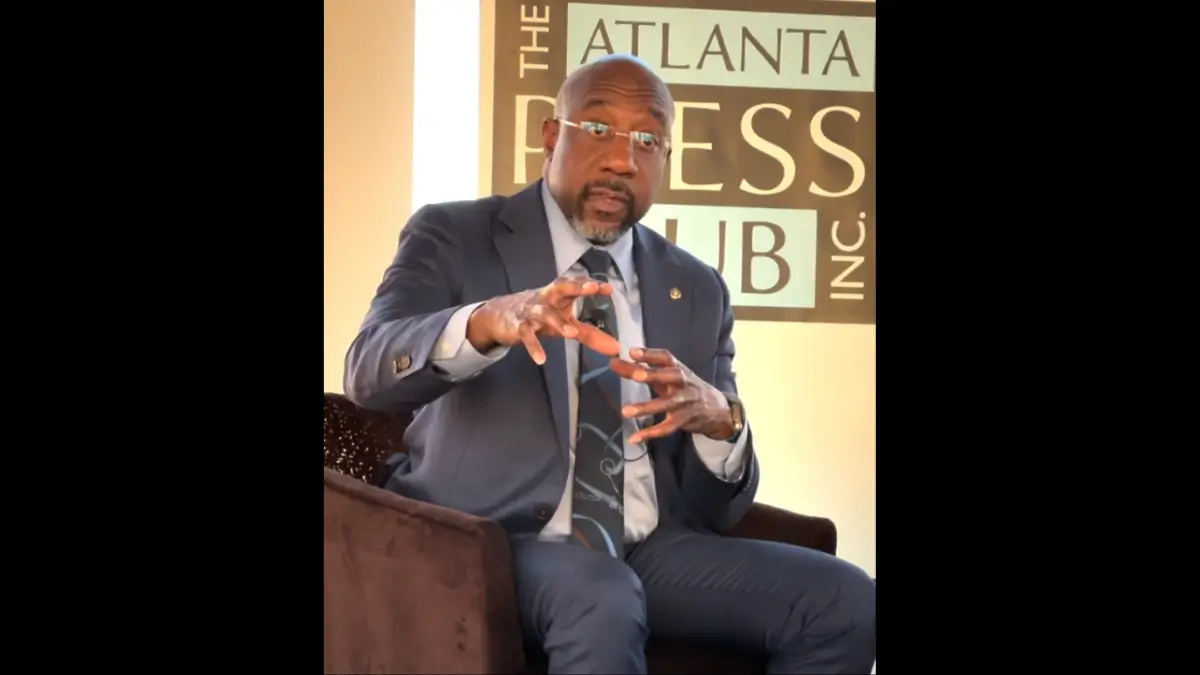
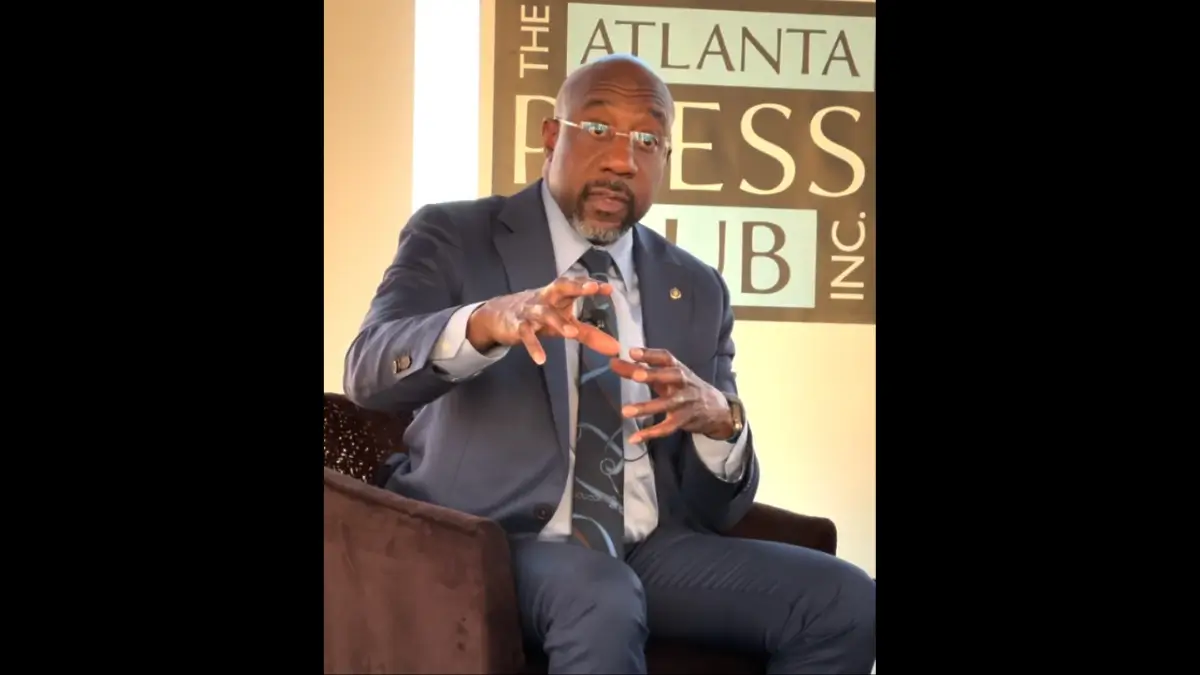
Speaking at the Atlanta Press Club last week, Warnock sounded buoyed by what he sees as a coming voter backlash against the “long assault by the [Chief Justice John] Roberts Court” on the Voting Rights Act and the resulting insult of racial and partisan gerrymandering to “advance the Trump agenda.”
Raphael Warnock Warns GOP Gerrymandering Could Trigger ‘Massive and Historic’ Voter Backlash
“Let me be real clear about what’s happening here,” said Warnock. “I don’t like gerrymandering. I don’t like partisan gerrymandering; I don’t like racial gerrymandering,” noting that he introduced a redistricting reform bill in Congress last year that would ban gerrymandering in redistricting.
“Nobody’s hands are clean here,” said Warnock. “Both parties have engaged in gerrymandering. But I have to tell you Republicans have been a lot better at it than us. They have been rabid and shameless.”
“They have literally introduced a situation where the voting practices of the Jim Crow era are now a 21st-century fight. And that saddens me. I’m a senator, I’m a pastor, but I’m the father of a 9-year-old and a 7-year-old. The Voting Rights Act has been gutted, and they have fewer protections than their dad. We’re moving in the wrong direction.”
“So here we are as we go into the midterms, the people will get a chance to have their say. The gerrymandering that we’re seeing in Tennessee, in Alabama, this cycle, in Louisiana, would seek to mute and diminish their voices. …The prediction is that we’re going to see massive and historic turnout come November,” Warnock forecasted.
“They’re engaged in this game of playing with the lines, and I think that they are running a huge risk that this will backfire on them. Because people don’t like taking their voices back. And as I go around, people are fired up about this. I think we are going to flip the House, and I think we have a very good chance of flipping the Senate.”
Georgia Early Voting Numbers Fuel Democratic Optimism Ahead of High-Stakes Midterm Elections
If early voting in Georgia is any indicator, a blue wave could be in the making. When polls closed last Friday, more than 1 million of Georgia’s 7.3 million active voters had cast advance votes for state and federal officeholders, a new state record for a primary election. And of those ballots cast, according to state elections data, about 580,000 were Democratic ballots, 428,000 were Republican, giving Democrats a 15-percentage point advantage.
Republican Georgia Gov. Brian Kemp said he was “definitely concerned” about the early Democratic advantage, WABE reported.
“I also understand there’s a lot of people that are still truly undecided, not just in the Senate race, but I think in a lot of the down ballot races,” he told reporters on Thursday at a campaign stop in Kennesaw with U.S. Senate candidate Derek Dooley, who seeks to unseat Democratic Sen. Jon Ossoff. “[It’s] been such an unusual year in the governor’s race where you got so much money being spent. The other money that’s being spent in down-ballot races isn’t really penetrating.”
Kemp decided after the Callais decision not to call for a special redistricting session in Georgia that would impact the midterm elections, as early voting was already underway in the Georgia primaries. But he has since called for a special session in June to redraw new districts in Georgia before the 2028 presidential election.
“It’s unfortunate that Georgia now joins other Southern states in this gerrymandering race to the bottom,” Warnock told the press club audience in Atlanta.
“My message to the Georgia Legislature is this: If you would actually do something to help the people of Georgia, you won’t have to keep redrawing the lines to manage the power of the people of Georgia. Apparently, some folks are afraid they’re going to be held to account come November. I think if you’re confident in the policies that you’re putting forward, you don’t have to keep redrawing the lines.”
Warnock Blasts Trump, Kemp and Congressional Republicans Over Medicaid Cuts and Iran War
Warnock faults both Trump and Kemp for making “draconian” cuts to Medicaid and for attaching work requirements to be eligible for the federal health care program.
Regarding the midterm elections across the country overall, Warnock said, “It’s hard to overstate how important this race is. We’re in a moment where we have a president who’s operating according to some theory of the unitary executive. And part of the beauty of our system is checks and balances. And sadly, his Republican enablers in Congress are just letting him run roughshod over Article 1. So we need some guardrails on this president.”
Noting that the president does not have the right to declare war without congressional approval, Warnock said the “unnecessary and illegal war in Iran” is threatening Americans’ security and causing economic hardship, from high gas prices to the price of fertilizer paid by farmers.
“And we haven’t had a single hearing about this war in Congress. That cannot stand. And the only way to hold him accountable in his last two years is to flip the House and flip the Senate. And we’ll have subpoena power and the ability to hold him accountable. … Not to mention you might have a couple of Supreme Court vacancies. And even though he has the White House, if we have the majority in the Senate, we’ll have a whole lot of tools right there to stop that in its tracks.”
While Democrats in the Senate have so far kept the House-passed SAVE ACT, which would require Americans to provide new identification documents such as birth certificates or passports to register to vote in federal elections, from passing in Congress, Warnock said fending off such “voter suppression” efforts will require a change in the balance of power in Washington.
And he said changing voter demographics in the U.S., which show the American voting-age population is increasingly younger and more racially and ethnically diverse, bode well for democracy.
“They’re trying to narrow the electorate. And so if you’re pulling your hair out watching what’s going on the last few weeks, and you’re wondering ‘What can I do?’ — You can make sure everybody in your circle is registered to vote,” Warnock said. “Tell them to check and make sure they’re registered. And you can mobilize people. Because they’re counting on people not turning out. Part of how we mitigate this is to defy the turnout models and turn out an electorate that looks like America. And that’s how we get better results.”