
High Profile Cases Of Black Femicide Are On The Rise. Is God Is Refuses To Look Away
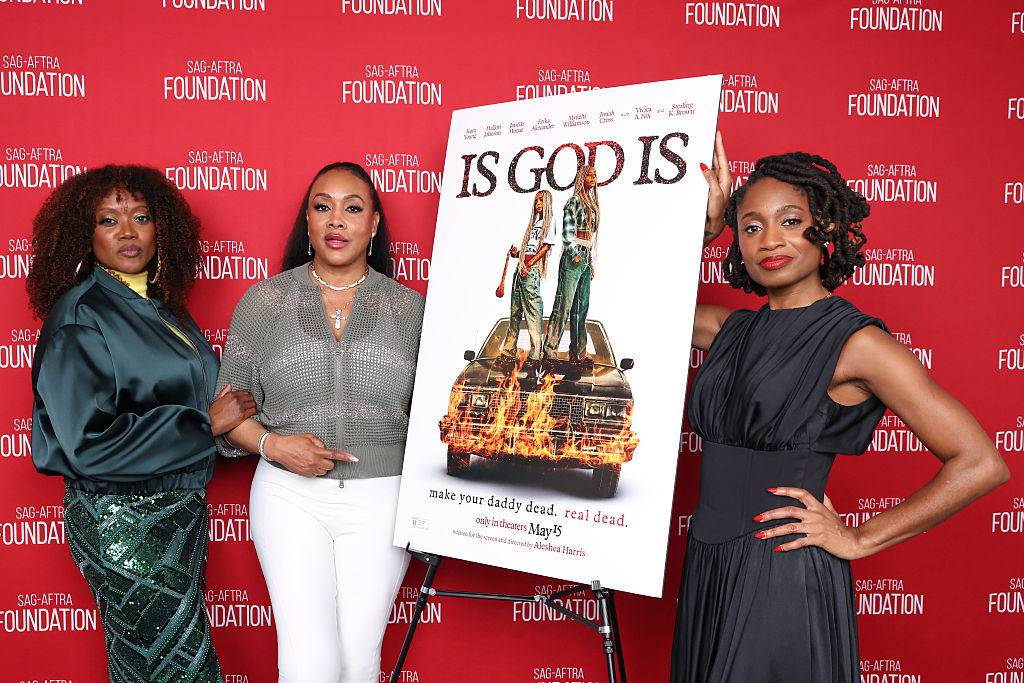
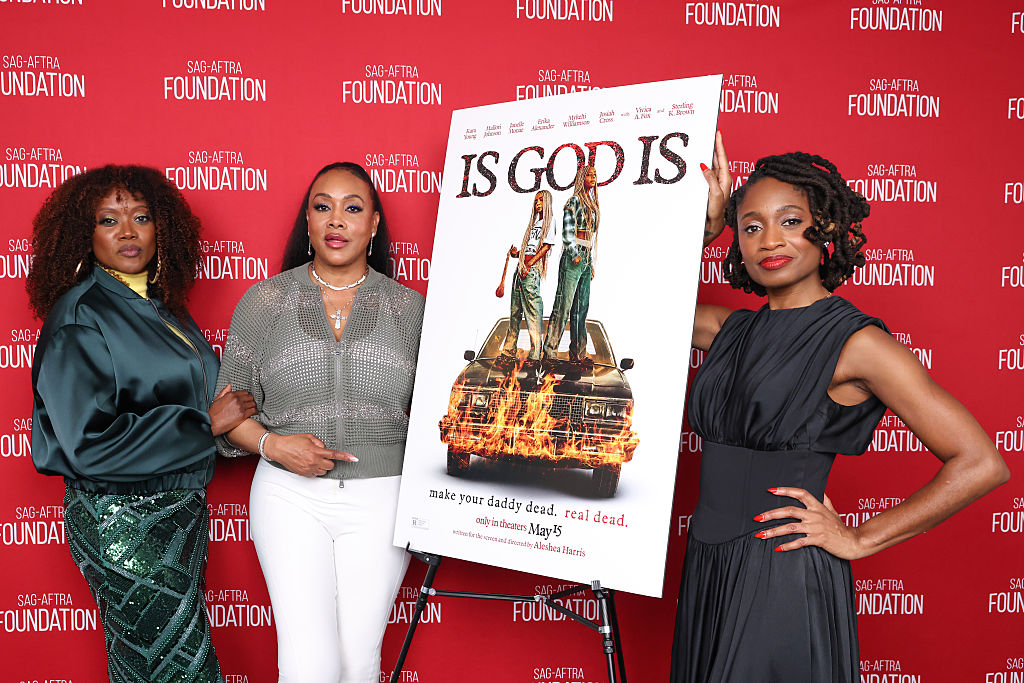
In writer-director Aleshea Harris’s film, Is God Is, twin sisters have been sent by their dying mother to kill the father who tried to burn their mother alive.
“This is destiny shit,” says Racine of the crusade their dying mother has handed them.
The mission to find their father, whom they call the Monster, becomes the spine of the film. It is a revenge story unlike anything Black cinema has offered before, one that hands Black women our anger rather than asking us to bury it.
Harris unabashedly treats the fury of her two main characters, Racine and Anaia as something righteous, earned, and long overdue.
The anger and rage Harris puts on screen meet a reality off-screen. Black women experience physical violence from intimate partners at twice the rate of their white counterparts. More than four in ten Black women experience this form of physical abuse during their lifetimes.
Just last month, three cases of Black femicide made front-page news. Pastor Tammy McCollum preached to her parishioners at her church in North Carolina on Easter Sunday. Hours later, she was shot and killed by her husband in their home. Their daughter saw no warning signs. So far, the investigations haven’t revealed any prior documented cases of spousal abuse. Pastor Tammy had publicly praised her husband.
Just four days earlier in Coral Springs, Florida, Vice Mayor Nancy Metayer Bowen was found dead in the home she shared with her husband, who has since been charged with murdering her.
On April 16th in Virginia, Dr. Cerina Fairfax, a dentist and mother of two, had filed for divorce and was navigating the legal process when her husband, Virginia’s former lieutenant governor Justin Fairfax, shot and killed her in the basement of their home.
All three were Black women. Each of them had done what they were expected to. Have a successful career. Marry a man. Build a life. Trust the system. None of those things saved them.
Harris is interested in why. In Is God Is, she props up those systems and their failures on screen through the women who have been in the Monster’s orbit.
The first is Divine, a storefront pastor played masterfully by Erika Alexander. The Monster fathered a child with her and left her while she was pregnant. In the years since, Divine has built an altar to him, their son has grown up, and she has spent decades waiting for him to return.
For Harris, Divine is encouraging us to interrogate the relationship between Black women, faith, and the men who get protected. “I want us to think about the ways that certain institutions ironically protect abusers and the kind of woman who would dismiss what the twins bring to her, which is, this person did this horrible thing to us, and instead be focused on the desire for that man and his greatness in her eyes.”
The Black church is often complicit and remains Black America’s most autonomous institution, which makes publicly indicting its men a perceived threat to the structure itself. Within it, Black men are often treated like demigods, and any critiques of them are rebuked.
Alexander juxtaposes that positioning with what Black people are denied in the outside world. “Think about how many times we don’t have power when we go walking down these racist streets,” she said. “But if you go into these houses of worship, you have your king, your queen, your first lady. You have all of that stuff. You have agency. You have power. You have access to money.”
The result is a closed system of influence that has traditionally flowed in one direction. “Every idea, you say, ‘Pastor said we gotta do this’ or ‘Pastor wants me to [do that].’”
What should be a safe haven for Black women has often been the opposite. The same institution that has long been considered a site of resistance against white supremacy has also taught its congregants to tolerate domestic violence. In so doing, it has sheltered Black men from the brutality of the outside world while becoming the platform from which abuse of Black women often goes unchecked.
According to Alexander, Divine has done what Black women have been doing for generations, often behind closed doors: “I think she turned herself inside out in order to stand next to a demon.”
Inasmuch as Divine needed the Monster, Alexander believes that women like Divine are essential to the survival of men just like him, who “cannot organize themselves in the same way or be as powerful without these women. And that’s who Divine is.”
Sterling K. Brown plays the man who needs Divine. As an actor, Brown has spent his career embodying the tender, respectable, dignified Black man and father figure women are inclined to trust on sight.
The men who hurt us are usually men we know. They are the deacons at our church, our husbands, our uncles, our brothers. The men who sit at the head of our dining room tables leading us in prayer before each meal.
With Brown, Harris was casting against type while making a larger statement about how men like the Monster get away with harming women. “Sterling exists in a particular way in the consciousness, and people are having all kinds of reactions to him in this role,” she remarked before adding, “That was very intentional for me. It also nods to the ways that these people, to do terrible things, often need to have a face that is very charming and disarming in order to get away with it.”
Harris cast against type again with Janelle Monae, who plays the Monster’s current wife, Angie. Monae has spent the better part of her acting career playing women who refuse easy categorization. She is perhaps best known through her music, where she has built an Afrofuturist wonderland centered on liberation.
Putting her inside the body of a woman who has chosen a carefully curated bourgeois cage is Harris saying this is a story about the women you might assume would never end up here.
Angie enters the film already halfway out of the door, leaving the Monster on her own schedule and with her dignity arranged around her quiet departure. Instead of treating the twin sisters she shares with him as kin, she treats them as lesser. She relegates them as two scarred girls that exist somewhere below the fancy life she had built and is now exiting.
If Angie were an archetype, she would be the bourgeois second wife at the first wife’s funeral, outdressing everyone in her finest couture paired with her grandmother’s pearls, and dark sunglasses she refuses to remove because, unbeknownst to the other funeral attendees, they are covering a black eye from the husband she and the dead woman share.
It is no accident that the Mother who set everything in motion is played by Vivica A. Fox. Audiences will remember her from Set It Off and Kill Bill, films in which Fox played Black women crushed by systems and forces larger than they were.
In this movie, Harris hands Fox the role of the Black woman who is the force. “Vivica can do anything, and she’s done many things,” she told me. “To take this woman and recast her, considering how we know her in those roles, and to give her the name of God, is to me such a powerful and audacious thing to do. We needed someone who could carry that, and she could do it.”
That audacity extends through every choice Harris makes in the film. Casting Fox as the woman her daughters name God is one of them. Building the world around her is another.
The Monster is the figure at the center of the revenge plot, but the daughters are the characters we are meant to walk out of the movie theater thinking about. The traumas that Racine and Anaia experienced didn’t start in their mother’s nursing home. They started after the fire, and they continued to accumulate as they journeyed through the foster care system, where they experienced abuse from foster parents. After they were taken from God, the system did not save them, either.
Harris is making another point here, too. Grief and the aftereffects of abuse don’t stay contained inside the women who survived them. They move outward into the family, where they harden into silence, fear, and inherited rage. The twin structure dramatizes that funnel by duplicating the wound. The trauma they share travels through two different bodies burned by the same fire.
“Even if it’s unspoken, there’s a feeling, a specter in the family about the terrible thing that happened in the past,” Harris reflected. That specter is what the twins have been raised inside. What Harris does with the twins is hand them the agency to confront it.
Black women have rarely been allowed to seek revenge on screen. We have been catechized even on film to read our endurance in the face of abuse as the holiness that brings us closer to God. The films that have let Black women go after the men who harmed us require those same women to die for it, be coded as criminal or villainous, or punished.
What Harris is doing on screen has almost no precedent in Black cinema. The closest precursors, perhaps, are the 1970s blaxploitation films Coffy and Foxy Brown with Pam Grier, and Kasi Lemmons’s Eve’s Bayou, all of which let Black women pursue vengeance.
Outside of those, the dominant framework for Black women abused by their partners has been Tyler Perry’s. His films often dramatize Black women’s abuse only to resolve those stories within narrow Christian frameworks that reaffirm the religious institutions committing the harm. The abuser gets punished, the woman leans into Jesus, finds a better husband, and the audience leaves with Black Christian patriarchy intact.
Harris refuses that resolution. There is no redemptive Black man in the final act and no arc for any of the Black men in the film that leads them back to grace. There’s only revenge.
Harris has made one of the few films that shows the impact of abuse on Black women in a fuller range – the anger, the grief, the desire for revenge, the refusal to shrink or disappear. Erika Alexander understands that the director’s ability to capture those emotions has far-reaching consequences.
“If we can disrupt the story system, we can change the trajectory of our own lives and people. Because it’s how they see us that has destroyed us to this point. But if we start putting out films that show us as human, that show the larger, fuller version of us, good, bad, and ugly, it’s hard to pull the trigger on somebody you see as human. It’s hard to put your knee on their neck. It’s hard to just come and take all their resources. We need that now more than ever.”
Alexander is exposing the narrowness of how Black women have been seen on screen. A narrowness that has dictated how we are seen off of it, that has followed us into boardrooms, courtrooms, emergency rooms, and every room built to shrink us. Is God Is upends that narrowness, and in refusing it, Harris shows that our full humanity, the ugly parts included, is what will keep us alive.
SEE ALSO:
‘IS GOD IS’ Reimagines The Revenge Genre Through Black Women’s Eyes
Erika Alexander Narrates New Audible Series ‘Finding Tamika’