
Black workers face new challenges as Trump labor policies reshape workplace protections

Labor leaders and lawmakers warn changes to federal agencies, jobs and worker safeguards could have a disproportionate impact on Black employees.
As Americans commemorate the Labor Day holiday, Black workers are facing significant barriers in the workplace as a result of President Donald Trump’s labor policies.
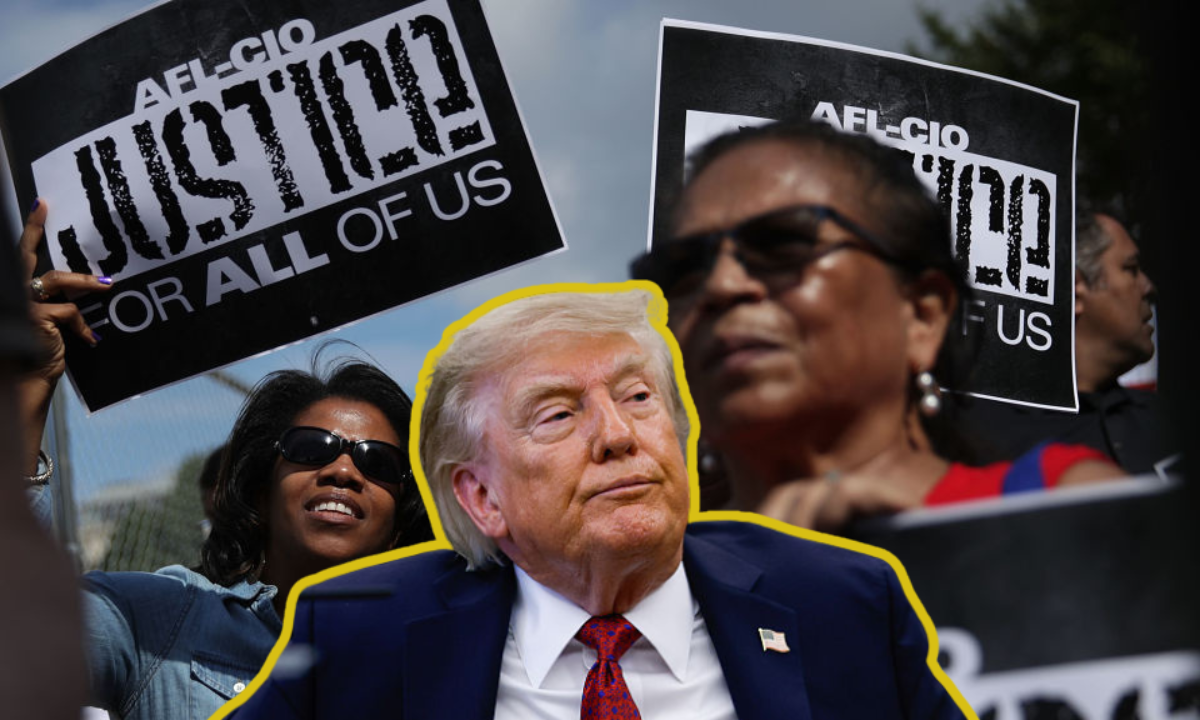
Black workers and other workers of color are facing the worst attacks in generations from the Trump administration,” says Fred Redmond, Secretary-Treasurer at AFL-CIO, the nation’s largest federation of labor unions.
The longtime union and civil rights leader says that as he travels and engages with Black workers across the country, he is finding there is no hope that Trump will do anything for them in terms of access to good-paying jobs, encouraging employers to hire Black workers, or ensuring worker protections like higher wages and safety from workplace hazards.
Since returning to the White House, President Trump has essentially taken an axe to the labor infrastructure that has safeguarded Black workers from racial discrimination and other employment harms. At the top of that list is the slashing of federal jobs under the guise of anti-DEI and waste reduction, including among federal contractors. For decades, Black workers have been statistically overrepresented in the federal workforce (20%). Federal jobs have also helped propel the Black middle class.
“Black workers are not holding their breath and waiting on this president to institute any program that’s going to benefit them because he has shown his hostility toward programs that level the playing field for Black workers, workers of color, and women,” Redmond told theGrio.

Trump has transformed powerful agencies within the U.S. Labor Department, like the Equal Employment Opportunity Commission (EEOC), the National Labor Relations Board, and the Occupational Safety and Health Administration (OSHA), that are tasked with enforcing civil rights and labor laws, which they have done on behalf of Black workers for decades.
The Trump administration replaced agency leadership with individuals tasked with executing his orders to prohibit diversity or racial equity programs and policies. Labor advocates say those very policies and programs met a very real need for Black workers, most especially Black women, who face historical and existing racial and gender disparities in employment, wages, and workers’ protection.
The need for these agencies is clear. Black Americans have the highest unemployment rate of any other racial or ethnic group. Millions of Black workers are either underemployed or make less in wages than their white counterparts. Not to mention, when employers are squeezed financially, Black workers are usually the first fired and the last hired.
The Trump administration turned its attention away from the very real racial disparities impacting Black workers, instead focusing on the so-called racial discrimination of white workers, specifically white men. However, white men earn more and have the highest rates of employment.
Critics of Trump say it is no coincidence that Black workers are seeing the highest unemployment rates in years and that more than 600,000 Black women specifically have lost their jobs since he took office.
“We know that the intention and the motive therein was to harm Black people,” says U.S. Rep. Summer Lee (D-Pa.). The progressive lawmaker who sits on the U.S. House Education and Workforce Committee tells theGrio that Trump’s “attacks” on Black Americans, specifically Black workers, have been both “explicit” and “implicit.”
“The attacks that have come through policies that maybe do not, on the surface, say this is an anti-Black policy, but that we know beyond a shadow of a doubt have had a disparate impact on Black people and the Black community,” said Lee. “The actions that he has taken on organized labor and just the workforce in general have had a devastating impact on Black people.”
If any one of the estimated 1.3 million unemployed Black job seekers or the estimated 20 million Black workers wanted to make claims of racial discrimination in employment, there’s less confidence that the agencies tasked with supporting them will do so under the Trump administration.
As theGrio previously reported, in July, the EEOC rescinded a rule dating back to the 1960s that requires large employers to collect and share data on the race and gender of their workforce. The move would make it harder for Black workers, as well as women and other marginalized groups, to make claims of workplace discrimination.
There are bright spots for some Black workers. Union members have seen increased wages over the years. Redmond tells theGrio that Black union workers make 12.6% more than Black workers who are not members. Black women represented by a union earn $9,000 more annually than Black women who are not unionized.
Despite wage gains, labor experts say Trump’s tariff, trade, and investment policies are threatening the livelihood of Black workers—from preventing even higher wages to the risk of many of those jobs being lost altogether. Advocates also worry about the looming impact of artificial intelligence as Trump touts billions in private investments in the United States.
Congresswoman Lee said that historically Black cities like her hometown, Pittsburgh, are at the center of the burgeoning industry.

“AI, automation, space, technology is Pittsburgh’s big thing right now, and there is a lot of conversation about how that industry is going to play out here, and not enough conversation about how historic Black communities and other marginalized communities won’t be left behind in these new emerging economies,” said Lee.
If Democrats win control of Congress after November’s midterm elections, the U.S. congresswoman says she would like to see AI regulation bills passed into law. Lee has introduced the AI Civil Rights Act, which would ban algorithmic discrimination and hold tech companies accountable for biased AI tools.
She told theGrio, “AI can be used to determine whether or not you get a job.”
Lee says it’s important to follow the money, as many tech CEOs who have cozied up to Trump backed him and Republicans in previous election cycles.
“They know that there is a direct payoff. That if they can help a politician get elected, then they can ensure that politician does not then turn around and say we need to put guardrails on AI,” she noted. “We need to put guardrails on this industry so that communities are protected.”
Redmond agrees, telling theGrio, “This president is determined to just tear down the architecture of our federal government and replace it with a system of corruption that benefits powerful CEOs and billionaires [and] union busters.”
However, the labor leader said that organizations like the AFL-CIO are determined to stand in the gap.
Redmond added, “We live by the premise that it was the workers in this country who wake this country up every morning and tuck it to sleep at night, and these are people that deserve to be treated with dignity and respect, and that’s what we’re going to fight for.