
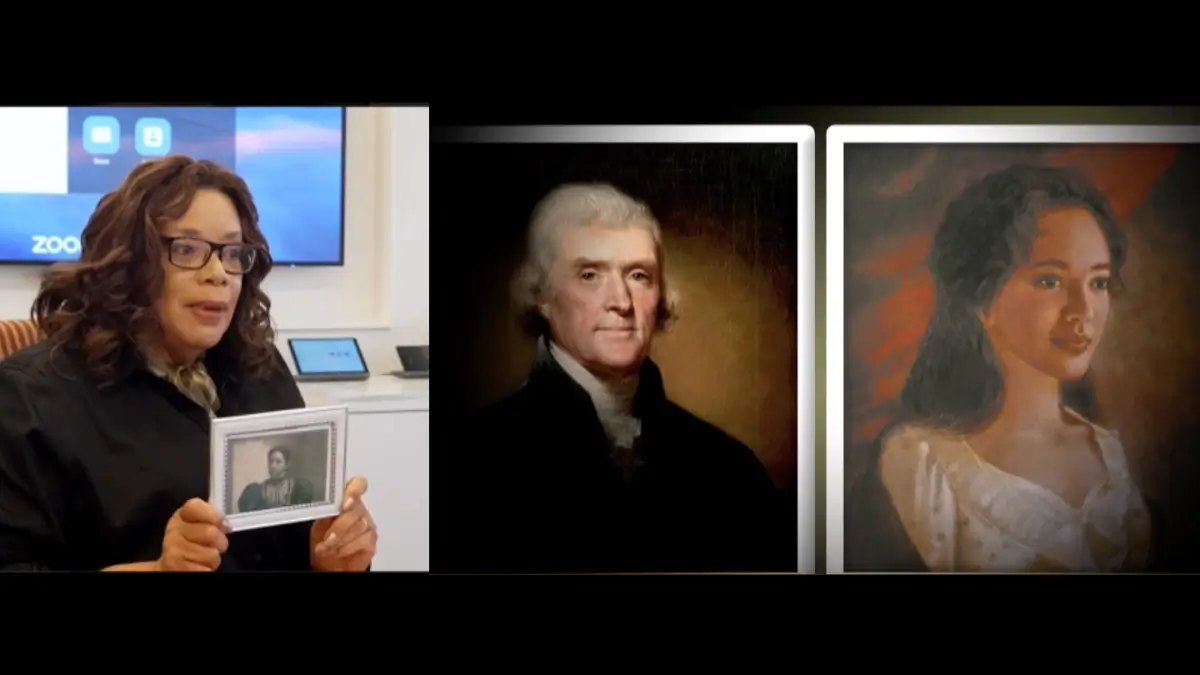
‘A 99.9% Chance’: Smithsonian Scientists Say New DNA Analysis of Thomas Jefferson’s Hair Shows He Fathered Sally Hemings’s Enslaved Children
A team of researchers at the Smithsonian Institution claim to have resolved the centuries-old historical and scientific debate over whether America’s third President Thomas Jefferson and Sally Hemings, a woman he enslaved, had children together.
The key to their scientific breakthrough: a lock of hair snipped from Jefferson on his deathbed in 1826.
Smithsonian scholar Richard Kurin co-authored a new book, “History by a Hair: Thomas Jefferson, Sally Hemings & Solving a 200-Year-Old Mystery,” set for release on September 22. It describes a 15-year research project that compared Jefferson’s preserved hair to DNA samples from 13 living descendants of Jefferson and Hemings in an effort to provide definitive proof of the genetic relationship between the two.

The findings show “there was a 99.9% chance that Thomas Jefferson had fathered a child of Sally Hemings,” Kurin told Today in an interview on Monday.
The book chronicles how Kurin, who led the effort, and a team of researchers that included archaeologists, genealogists, molecular geneticists and historians used cutting-edge techniques to extract and sequence Jefferson’s DNA from his hair, The New York Times reported. Kurin now maintains they’ve produced “compelling,” “clear,” and “extraordinary proof” that he fathered Heming’s children.
The Smithsonian team’s research builds on previous scientific and historical work linking the former president and Hemings, the Times noted.
A 1997 study by Harvard scholar Annette Gordon-Reed, the author of two acclaimed books about Jefferson and Hemings, found that earlier historians had blindly trusted white narratives while discounting statements left by Heming’s own children and relatives about Jefferson’s paternity of six of her children and analyzed documents showing the coinciding physical presence over time of Jefferson and Hemings at his estate in Monticello, Virginia.
In 1998, pathologist Eugene Foster published a DNA study in the journal Nature that indicated Heming’s son Eston was the son of a Jefferson male, and most likely Thomas Jefferson.
The Thomas Jefferson Memorial Foundation, the nonprofit group that owns and operates Monticello, concluded in 2000 that Jefferson was “most likely” the father of her other children. In 2018, the foundation declared it “a settled historical matter” that he sired all of her children.
But some people remained skeptical, including historians, scientists and some descendants of both Hemings and Jefferson, who said other paternity candidates exist, including Jefferson’s brother, Randolph.

Kurin told Today that he began investigating whether Jefferson fathered Hemings’ children in 2011 after learning from a documentary that someone had discovered a strand of Jefferson’s hair in his personal Bible.
“If we can get Jefferson’s DNA, we can solve a 200-year-old mystery of American history,” Kurin said he thought.
“How can a man who writes, ‘All men are created equal’ have his own children, not equal, and not having freedom?” Kurin asked. “I knew people had a great stake in it.”
The strand of hair from Jefferson’s Bible, discovered by staff at the Smithsonian’s National Museum of American History in 2009, turned out to be a bust, and not genetically related to Jefferson.
But then the Monticello foundation told the researchers they would make available a packet of hair from their archives labeled, “Thomas Jefferson, cut the day of his death, July 4, 1826.”
DNA testing, cross-referenced with male and female descendants of Jefferson, confirmed it to be his, Kurin says.
To achieve that, the team of paleo geneticists from University of California at Santa Cruz developed a groundbreaking new method of extracting and sequencing DNA from rootless hair, which had proven nearly impossible before, the Chronicle of Higher Education reported. (Researchers have since used that technology to identify serial killers from hair left at crime scenes, including the Golden State Killer and suspects in the Gilgo Beach murders.)
Then Kurin and his team spent years collecting DNA from living Jefferson and Hemings descendants. The genealogists focused on finding fifth-generation descendants, some of whom were already in their 80s, because they would likely be the last descendants with enough Jefferson DNA — an average of roughly 3.1% — to produce a clear match, the Times reported.
Nine of the 13 samples they ultimately retrieved came from fifth-generation descendants of Hemings via her sons Madison and Eston, who shared between .5 and 5 percent of DNA with Jefferson, within the range expected for a fifth-generation descendant.
The team also got data from two fifth-generation Jefferson descendants through the line of his daughter Maria, who shared 2.4 and 2.6 percent of his DNA, and two descendants of Jefferson’s brother, Randolph.
A computational biologist working with the team used the data to run 20,000 simulations of each paternity scenario involving Jefferson, Randolph or Randolph’s son. The odds that Jefferson did not father either Madison or Eston were less than one in a thousand, the Times noted.
It turned out the person with the highest percentage of shared DNA with Jefferson, at 5 percent, was Clara Lee-Nutt, a Hemings descendant who provided her DNA in 2024.
Nutt told Today that her mother had informed her of their distant relationship to Jefferson, based on family lore and genealogy. But she says she learned just how sensitive the topic was during a seventh-grade class trip to Monticello, when she asked during a tour of Jefferson’s house, “Hey, so where did Sally Hemings sleep?”
She said the tour guide snapped at her, “There is no evidence that that woman ever set foot in this house.”
“I remember that bus ride home, where I thought, ‘I’m done. I will never talk of this again,’” Nutt recalled.
Armed with the new, more conclusive DNA findings from the Smithsonian, Nutt says, “It’s really wonderful to have the validation for my children, and the fact that I could pass on the information to them without caution. I could speak boldly and just say, ‘This is who you are.’”
But not all descendants of Hemings and Jefferson are on board with the researchers’ pronouncements.
Mary Brady-Atkins, who is Hemings’ 98-year-old great-great-great-granddaughter and her oldest living descendant, participated in Kurin’s research project and provided a DNA sample. But she now says she has lost trust in him and the other scientists involved because they plan to publish a book about their findings before a scientific journal has vetted their research through peer review.
A retired Michigan State University professor with a Ph.D. in psychology, Brady-Atkins told The Chronicle that her five decades in academia taught her, “A finding is submitted to a journal. It is reviewed by those an editor selects rather than by those the investigator selects. It is published together with the data supporting it, so that others may test it. Only afterward is it written about for a general audience.”
Because she questioned the research’s validity, she demanded that the team destroy her DNA samples and remove them from the study just as the authors prepared to publish the book and embark on a national tour. The Smithsonian also canceled Kurin’s lecture celebrating the book this month.
Two of the scientists involved with the study told The Chronicle that the team removed her sample and re-ran their analysis, finding that Brady-Atkins’s data was “largely redundant” and removing it had virtually no effect on the results.
During a mid-July webinar with more than 15 Jefferson and Hemings descendants, Kurin told them there was a “more than 99.9 percent chance” that Jefferson fathered children with Hemings and said a scientific journal would publish an article alongside the book’s September release. He cited three experts in genomics who had peer-reviewed the methods and findings of the research.
John H. Works Jr., a seventh-generation Jefferson descendant, and a New York-based lawyer and financier, who has previously questioned the paternity of Thomas Jefferson (versus Randolph Jefferson) to Hemings’ children, also has his doubts. He repeatedly asked Kurin to name the scientific journal and provide its publication date, but Kurin refused.
Works told the Monticello Association that it should not feel “pressured into reaching a determination on paternity” before researchers allow it to review the basic science and a “bona fide peer-reviewed internationally recognized scholarly” publication critiques it.
The Smithsonian, recently under fire from the Trump administration for allegedly promoting “divisive, race-centered ideology,” has also been cautious with its public rollout of the research and the book.
The Times observed that the Smithsonian moved the Sept. 22 event announcing the findings from the American history museum to a less prominent location. The event limits attendance to descendants and bars the media. The Smithsonian also canceled Kurin’s online lecture scheduled for the following day.
In an interview, Kurin said neither he or the Smithsonian invented the question at the center of his research, which “goes back to Hamilton and Jefferson and Adams. If we have evidence, scholarship and science that helps elucidate American history, I think we have a duty to pursue it.”
Lonnie G. Bunch III, the beleaguered Smithsonian director who announced his retirement at the end of this year, writes in the forward to the book that the research “helps resolve an issue that had divided us since the time of our national founding, and points to how science, scholarship and education can bring us together as people of one, albeit complicated, American family.”