
Putting ‘Profit Over Safety’ Led to ‘Traumatic Loss’: Relatives of Black Victims of Fatal Sapelo Island Gangway Collapse File Lawsuit Charging Construction Firms with ‘Alarming Incompetence’
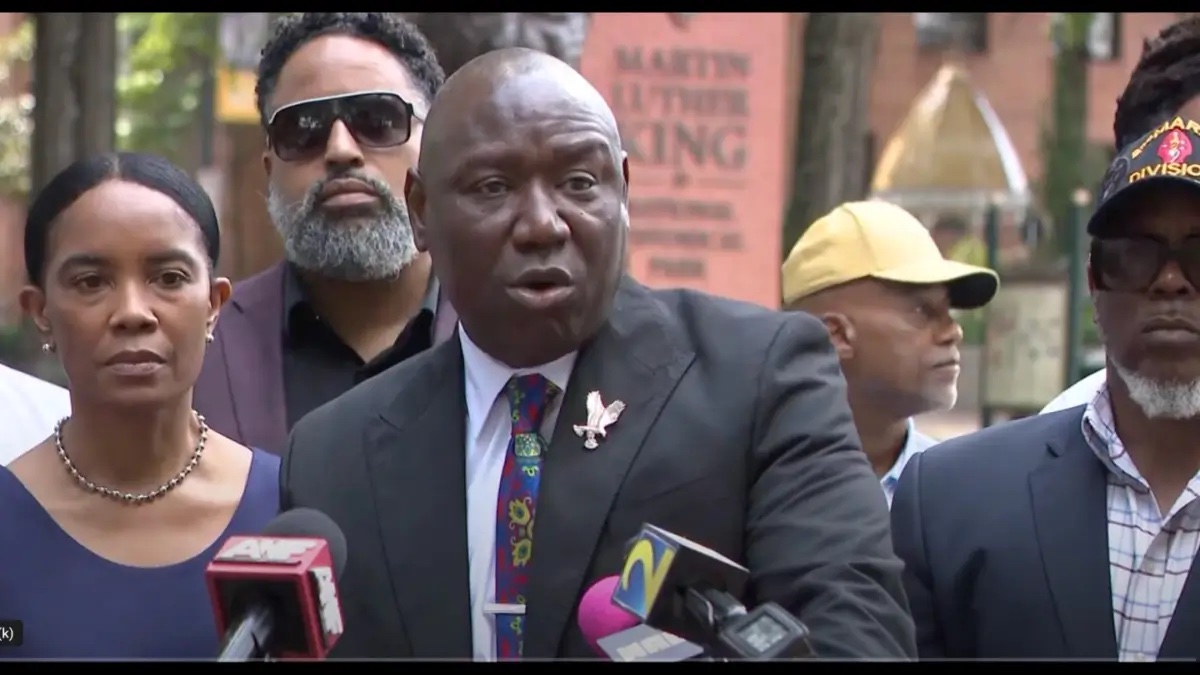
Civil rights attorney Ben Crump and relatives of seven elderly people who died last fall when a ferry dock gangway over turbulent waters at Sapelo Island on Georgia’s coast collapsed held a press conference in Atlanta on Wednesday to announce their multimillion-dollar lawsuit against the companies that designed and built the aluminum structure.
Dozens more people were injured on the afternoon of Oct. 19 as they walked across the narrow, 80-foot walkway connected to a floating dock to board a ferry boat to take them to the mainland. The gangway suddenly snapped in the middle, sending about 20 people plunging into the swirling tidal water and fighting for their lives.
Some, like Regina Brinson, could not swim.

She described helping Carlotta McIntosh, 93, who was using a walker to get across the gangway when she heard a “crack” and then saw her family friend plunge into the water. Brinson and her uncle, Isaiah Thomas, 79, also fell in and were quickly carried away by a rough current.
Brinson said she tried to help her “Uncle Bubba” stay afloat, but as he pulled her underwater, she had to escape his grip by peeling his fingers one by one off of her shirt to avoid drowning. She watched him drown, and eventually doggy paddled to shore.
Both McIntosh and Thomas died.
“This has not be easy for me, not at all,” said Brinson, a plaintiff in the lawsuit who said she is still plagued by nightmares and sees a therapist to help her cope with the trauma from the incident.
She numbered among about 700 people who had visited Sapelo Island that day for the annual celebration of the Gullah Geechee community, history and culture still surviving in a small part of the island called Hogg Hummock, founded by enslaved people who were descendants of West and Central Africans.
“This was supposed to be a celebration of Black pride, but it became a great, great, great Black loss of humanity and life,” said Crump, one of several attorneys representing 60 plaintiffs in the lawsuit, including seven people who died (six of whom were African-American), 30 who fell into the water or were otherwise injured, and many of their surviving family members.
“That day was horrific,” said Nathaniel Hicks, who recounted how his mother, Joann Ross, who cannot swim, was swept out by the strong current flowing under the dock, located where the Turpin River meets the Atlantic Ocean. She was rescued by a younger woman, but suffered a badly broken ankle, and continues to “hobble,” he said.
“There was no expectation of danger when any of them stepped out on that platform, and this has to be addressed,” said Hicks.
“When people put profit over safety, you have the traumatic loss” that the deceased and the survivors have endured, Crump said.
The lawsuit, filed on Wednesday in Gwinnett County State Court, accuses defendants Stevens & Wilkinson, the design firm which managed the project; Centennial Contractors Enterprises, the general contractor; EMC Engineering Services, the civil/structural engineer; and Crescent Equipment Co., which designed and built the gangway, of “sheer and alarming incompetence” in how they collectively designed, approved and built a structure that was “destined to fail.”
The gangway “was so poorly designed and constructed that any competent construction professional should have recognized the flimsy and unstable nature of the gangway and its poor build quality during installation procedures and sounded the alarm,” the complaint says.
The genesis of the gangway and dock project at Sapelo Island Marsh Landing Dock was a 2015 lawsuit in which residents of Sapelo Island filed a lawsuit against McIntosh County, the Georgia Department of Natural Resources (DNR) and other state agencies alleging discrimination on the basis of race and disability.
After a 2020 settlement, the state was required to make repairs to two docks serving Sapelo Island, which included constructing new wooden piers, aluminum gangways and concrete floating docks.
DNR hired the private construction firms to design, build and install the gangway at Sapelo, which was completed and installed in 2021.
The gangway was supposed to be designed and constructed to withstand an evenly distributed load of 64,000 pounds, the complaint says, which would equate to 320 persons.
“In reality, it was under designed by many orders of magnitude, poorly constructed and incapable of safely withstanding even a fraction of the specified and required live load,” the lawsuit says.
“We’ve had experts take apart the gangway and reconstruct the gangway,” said Jeff Goodman, a Philadelphia attorney representing several plaintiffs, and known for representing clients in structural collapse cases, at the press conference. “And what that has proven with clarity is that this gangway was capable of supporting less than one third of what it needed to.”
Crescent Equipment failed to provide design calculations and drawings reviewed and signed by a professional engineer as required by its contract with DNR, “which should have been an insurmountable roadblock” to the design being approved and the gangway installed, the complaint contends.
Crescent Equipment also allegedly cut corners on materials, using a 2 ½ inch diameter pipe for a major structural element of the gangway, when the industry standard to support the desired load was to use a 6” x 8”, ½” thick rectangular tube, the lawsuit says.
The weld quality on the Sapelo gangway was also poor and “observable” and should have been noticed during inspections, the complaint contends.
After the gangway was installed, Centennial Project and Crescent Equipment were advised that it had been making “strange and concerning noises” and were asked to reinspect it.
An email chain referenced in the complaint from May 25, 2022, that was released by DNR revealed the DNR Sapelo Island manager had received two separate reports that a loud ‘pop’ or ‘crack’ noise was heard on the aluminum ramp by University of Georgia employees who were regular ferry riders.
Centennial Project Manager Tim Dugan responded on May 26 that he had conducted an inspection and noted several cracks in underside welds connecting deck planks to the structural members of the gangway but said he observed no issues “that would cause concern for the structural integrity of the gangway.”
Another contractor suggested reinspecting the gangway in a few months “to see if there [are] any additional weld failures and if so, decide what corrective action should be taken.”
The fact that welds were already failing on the gangway just a year after it had been installed should have spurred Centennial to totally reevaluate the structure, the lawsuit argues.
And when, a few months later in September 2022, a different gangway designed and manufactured by Crescent and installed at a dock at St. Mary’s, Georgia “suffered a failure and caused injuries to 17 people who fell when it failed,” the cause for concern over the quality and integrity of the Sapelo gangway “should have heightened,” the plaintiffs assert.
The cause of the Sapelo gangway collapse remains under investigation by state officials, a DNR spokesperson told The Associated Press, which noted that Georgia Attorney General Chris Carr also engaged a private engineering firm to perform an independent investigation.
“This tragedy was easily preventable had it not been for Defendants’ negligence, recklessness and outright abdication of their important responsibilities with respect to ensuring the safety of the subject gangway,” the lawsuit says.
“This tragedy was not just preventable; it was inevitable,” said Goodman. “It wasn’t a matter of if this gang way would collapse it was a matter of when this gang way would collapse, and the failures happened at the design level, at the engineering level, and at the construction level and that is why the lawsuit that has been filed seeks to hold those design, engineering and construction professionals accountable for this senseless and unnecessary loss of life.”
The complaint asks for a jury trial to determine unspecified compensatory, special and general damages for negligence, wrongful deaths, personal injury and survival claims.
Crump, who twice referred to the case as a “multimillion-dollar lawsuit,” said, “We’re filing this lawsuit to speak to that tragedy, to say that we won’t let them sweep it under the rug, we won’t let them say these Black people were insignificant … that these Black senior citizens were irrelevant …that their lives didn’t matter. … We’re dealing with yet again trying to remind people that Black tears are just as valuable as white tears.”
Attorneys for Crescent Equipment and Centennial Contractors declined reporters’ requests for comment, and Stevens & Wilkinson and EMC Engineering did not immediately respond to such requests.
The defendants have 30 days, or until July 11, to file a response to the complaint.