
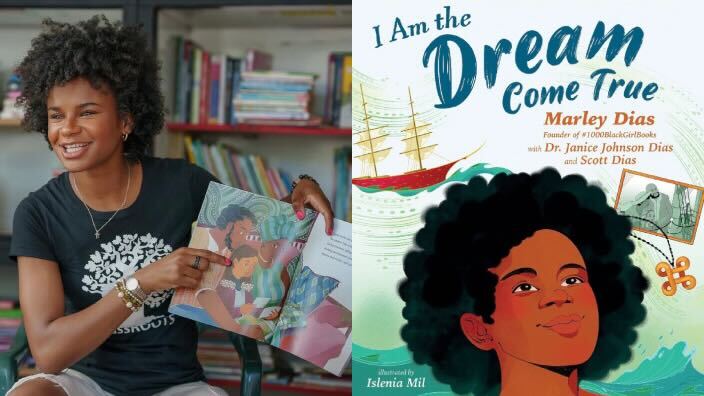
Marley Dias wants Black children to know the stories that made them possible
Marley Dias reflects on family history, Black representation and the inspiration behind her new book, “I Am the Dream Come True.”
“This book is a love letter to families.”
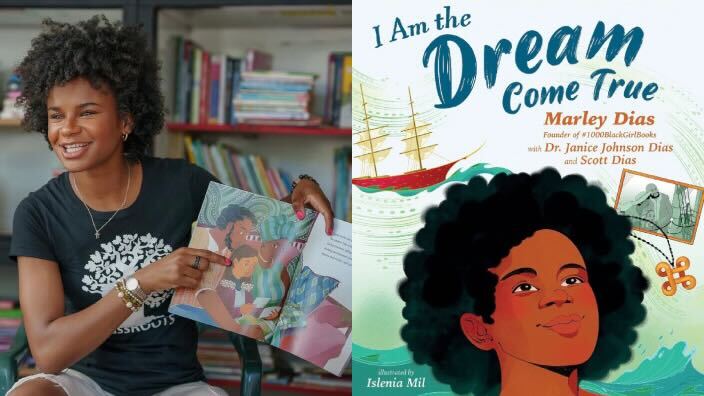
That’s how author and activist Marley Dias describes her new children’s book, “I Am the Dream Come True,” a collaboration with her parents that traces generations of family history from Jamaica and Cape Verde while encouraging young readers to understand the people and decisions that came before them.
“A love letter that doesn’t make demands of you, it just affirms you,” Dias told TheGrio. “That’s the register we wanted for this book. The lessons are there, but they sit underneath the affirmation rather than in front of it. I think kids absorb history better when it’s offered to them rather than assigned to them.”
Dias, who launched the #1000BlackGirlBooks campaign at age 11 after noticing a lack of books featuring Black girls, has spent much of the last decade advocating for representation in children’s literature. In “I Am the Dream Come True,” she turns her attention to her own family’s story. She said she wanted children to see the title as more than an inspirational phrase.
“I try to ground it in specifics rather than leave it as a slogan,” she said. “It’s not ‘you are the dream’ in some sweeping sense, it’s ‘this specific person made this specific decision so you could exist in this specific way.’ When you trace the phrase back to actual choices people made, it stops being inspirational language and becomes a fact a kid can actually use.”
The book also represents a unique family collaboration. Dias co-authored it alongside her mother and father, a process she said required more work than simply putting stories on paper.
“It required real negotiation,” she said. “My mom, my dad, and I had stories we’d only ever told each other, sometimes inconsistently, sometimes with disagreements about details. Co-authoring meant we had to align on a shared account before we could hand it to readers. That process was more demanding than I expected.”
Identity and ancestry are recurring themes throughout the book, and Dias said she was introduced to both at an early age through her own name.
“My mom named me after Bob Marley specifically so that Jamaica’s history would be attached to me before I could understand it myself,” she said. “So identity arrived ahead of comprehension, in a sense. Every time someone asked about my name, I had to explain a country and a history before I could finish introducing myself.”
The experience also influenced how Dias thought about representation and whose stories are considered important enough to be included in the spaces where children learn.
“That taught me early that my identity would always come with some context attached, and that I could treat that as an asset rather than a complication,” she said.
She said that understanding was reinforced by her father’s Cape Verdean heritage, particularly when she noticed the country was missing from many of the educational materials she encountered growing up.
“When your father’s country isn’t marked on the classroom globe, you absorb a clear message about whose history gets included by default,” Dias said.
That search for representation would later become the foundation of #1000BlackGirlBooks. Looking back, Dias sees a connection between the campaign she launched as a child and the work she is doing today.
“At 11, I was responding to a specific frustration,” she said. “I asked my mom a direct question, and the answer became a campaign and global conversation. Ten years later, that campaign has become two books. The fifth grader who couldn’t find herself represented is now actively building that representation.”
For children who may still feel unseen, Dias offered a message rooted in her own experience.
“I’d tell them what I had to learn at 10: the absence isn’t proof that you don’t matter, it’s proof that the work hasn’t been done yet,” she said. “And you don’t need permission or institutional backing to start doing it yourself. I was a kid with a question and a laptop. That’s a sufficient starting point.”
The book also highlights the generations of family members whose efforts created opportunities for those who came after them.
Among them is Dias’ great-grandmother, Margaret Taylor, who was one of the few landowners in St. Mary, Jamaica. While reflecting on her family’s history, Dias said she views each generation as part of a larger story.
“I think of it less as a standard to meet and more as a sequence of responses to different circumstances,” she said. “Margaret Taylor sold textiles because that was available to her. My mom built a nonprofit. I started a campaign. None of us were competing with each other, each of us was responding to what our specific moment required. That framing keeps the pressure manageable.”
Dias said she now realizes how much of her advocacy stems from lessons passed down through generations of women before her.
“It happened gradually, through moments where my mom would point out that an instinct or phrase of mine actually traced back to women before me,” she said. “I started to recognize that my impatience with the lack of representation wasn’t original to me, it was inherited.”
Ten years after launching #1000BlackGirlBooks, Dias said she no longer sees her advocacy as something she started on her own, but as part of a legacy that began long before her.
“Once I saw that pattern, the work stopped feeling like an individual project and started feeling like a continuation of something already in motion.”