
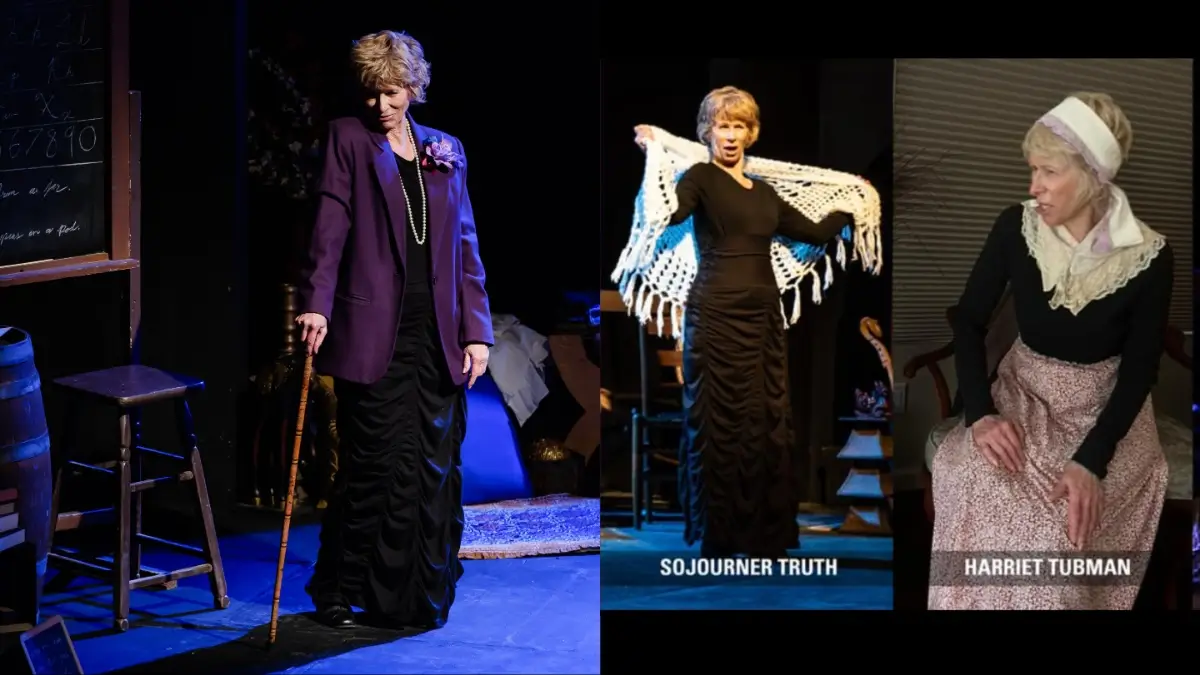
‘It’s Not Appropriate’: White Actress Sues After San Diego Library Cancels Her One-woman Show Where She Plays Harriet Tubman and Other Black Civil Rights Leaders
A white actress is suing the San Diego Library for racial discrimination after it canceled her one-woman show in which she portrays historic Black civil rights figures, including Harriet Tubman.
County administrators thought some library patrons might find her performance culturally insensitive.
Annette Hubbell, 76, has been presenting her “Woman Warriors” show, paying tribute to the women she most admires, for five years at venues across the country. In it, she brings to life a roster of extraordinary female characters, Black and white, which her lawsuit describes as “ordinary women who transformed themselves and left the world a better place.”

They include poet Anne Bradstreet, abolitionist Harriet Beecher Stowe, Jewish resistance leader Corrie Ten Boom, civil rights leaders Mary McLeod Bethune and Sojourner Truth, and Tubman, the iconic escaped enslaved woman turned abolitionist and suffragette.
In May 2023, Hubbell signed a contract with San Diego County to perform an abbreviated one-hour version of her show for a performance at the Rancho Santa Fe library branch as part of its Women’s History Month programming scheduled for March 21, 2024.
Given a choice of eight characters, the branch manager, Christina Patterson, asked Annette to portray three historical American women: Stowe, Bethune, and Tubman.
Two weeks prior to the performance date, Patterson asked Hubbell to switch out Tubman and Bethune, the two African-American figures, for two white characters, explaining that “our administration was uncomfortable with you performing a Black character as a white woman.”
Taken aback, Hubbell phoned the branch supervisor, Rebecca Lynn, and asked her whether she could “only honor women of courage and integrity if they’re white.” Lynn confirmed this was so, saying, “That’s pretty much it,” the complaint, obtained by Atlanta Black Star, says.
“And I said, ‘Why?’ Hubbell recounted to KBPS. “And they said, ‘Because it’s not appropriate for you to be doing this. You’re a white woman.’ And I said, ‘Oh, no, no, no, you don’t understand. I’m honoring these women I have so carefully researched,” Hubbell said. “And they said, ‘That doesn’t matter.’
Hubbell said she pressed Patterson to explain, asking, “‘Well, tell me how this is different from the ‘Hamilton’ play.’” In “Hamilton,” non-white actors portray white historical figures.
“And she replied, ‘That was historically different.’ And I said, ‘I don’t understand that. Explain that, please.’ And she said, ‘I can’t explain it. And frankly, I’m quite baffled that you don’t understand,” Hubbell recalled.
Hubbell told Patterson she would decline to perform if the library prohibited her from portraying certain historical figures because of race, noting that Bethune “had once been rejected from a job as a missionary because of her race, and asked how this was different,” the lawsuit says.
Later that day, the library canceled Hubbell’s performance.
Hubbell then complained about what she considered discriminatory treatment to San Diego County Supervisor Joel Anderson, prompting a review of the matter among county administrators and the Diversity and Inclusion Team, who agreed with the decision to ask Hubbell to perform different characters, finding it was not discriminatory.
On March 11, 2024, Hubbell posted on Facebook, “I have never had a negative comment in the five years I’ve been doing this. Indeed many black people have thanked me for honoring these women, which I do.”
Other than costume changes, she does not use special makeup or exaggerated effects to enhance the characters in her performance, Hubbell wrote in an opinion piece in the San Diego Union-Tribune.
“I simply draw upon their words and ideas to give life to these remarkable women, who most people might only know from reading about on the page,” she said. “There’s nothing unusual about actors portraying historical figures of differing races.”
“I think if people thought I was doing blackface or a parody of these people not respecting them, then that might be a cause for an objection,” she told KBPS. “But all they have to do is read my stories and the testimonies on my website, and they would see how deeply I respect and honor and admire these people,” she said.
Hubbell’s one-woman play was adapted from her 230-page book published in 2019, “Eternity Through The Rearview Mirror: How Simple Faith Changes Everything — Seventeen Extraordinary Lives,” chronicling the lives of 17 historical figures who changed the world.
In her opinion piece, she said in theatrical appearances “from progressive California to deep red Alabama,” she has “brought these heroic women to life with the sensitivity, respect and honor they deserve” without any issue, until last year.
Her lawsuit, filed in U.S. District Court in California on May 1, claims that county officials denied her “the opportunity to pay tribute to America’s heroines solely because of her race,” in violation of her Fourteenth Amendment right to equal protection, federal civil rights laws prohibiting discrimination in contracting and among programs receiving federal financial aid, and similar anti-discrimination laws in the California Constitution.
The lawsuit states that after the San Diego County Library (SDCL) canceled her contract, Hubbell was left feeling embarrassed and humiliated, and that “other opportunities to perform diminished,” including an educational program for senior adults in San Diego, which backed out of an agreement for her to perform her play.
“If SDCL’s discrimination is allowed to persist, it will normalize government restrictions on actors and performers based on race, unfairly hindering artistic expression and opportunity,” the complaint says.
Hubbell is represented pro bono by attorneys from the Pacific Legal Foundation, a libertarian public interest law firm that has filed suits against implicit bias training, “race quotas” for licensing boards, and programs meant to close opportunity gaps, noted KBPS.
Hubbell’s lawyer, Chris Barnewolt, stated that they aim to establish a legal precedent with this case.
“We want to send a clear message that the government has a duty to every individual to treat them equally and to treat them fairly. If the San Diego County government can make decisions based on race in this instance, then any county or local government could do the same. And we want to make sure that stops here.”
She seeks a court injunction forbidding the defendants, who include the San Diego Library and its director; San Diego County, its chief administrative officer and the county board of supervisors “from treating individuals differently on the basis of race when approving or denying library programming.”
Hubbell also requests that the court award unspecified compensatory and punitive damages, as well as nominal damages in the amount of $1.
In the defendants’ motion to dismiss the lawsuit filed on May 28, attorneys representing the library and county argue that while Hubbell invoked anti-discrimination laws to require the library to be colorblind in casting the production, the library’s right to free speech trumps that claim.
The First Amendment allows the library to decide that “a white woman, no matter how skilled and accomplished, was simply not the person it wanted to speak the words of and perform from the life of famous Black women like Mary McLeod Bethune or Harriet Tubman for the education and entertainment of its customers,” the defendants contend.
The motion to dismiss cites federal cases in which courts have determined that “a government entity has the right to ‘speak’ for itself,” including Green v. Miss USA, in which the plaintiff, a transgender female, argued that an Oregon anti-discrimination law required the national Miss USA beauty pageant to allow her to compete, despite the pageant’s “natural born female” rule.
The Ninth Circuit rejected that argument, the motion says, “holding it would violate the pageant’s free speech rights to produce an expressive event to communicate a message of encouraging and empowering women who were born female.” In its ruling, “the Court presented an extended discussion of race-conscious casting in the Broadway musical ‘Hamilton,’ describing the musical’s ‘decision to cast the predominantly white Founding Fathers with actors of color ‘as an ‘expressive decision that was central to the message of the musical itself.’”
“Had some anti-discrimination statute been applied to ‘Hamilton’ forcibly to include white actors, the court considered, the show simply would not be able to express the message it desired,” in violation of the First Amendment, the defendants observe.
The San Diego Library was in effect the producer of Hubbell’s “inherently expressive dramatic performance,” the motion argues, and that included “selecting the characters to be portrayed.”
“Defendants do not claim any broader right to physically close the Library to white customers (or to customers of any race). Defendants claim only the right not to express a particular unintended message that they do not wish to express that would be ‘inescapably interwoven’ into any performance in which a white woman would speak in the first-person perspective as a Black woman. … Dismissing this case based on these narrow speech rights would be a good thing.”
The motion further argues that “coercing the Library’s speech through the application of anti-discrimination laws” would “inevitably weaken the Library’s ability to function and pursue its missions.”
If anti-discrimination laws applied to such speech decisions, the motion asserts, “it is hard to see how libraries could choose not to produce what has been come to be known as Drag Queen Story Hour events (in which drag queens read children’s books to young children at public libraries) if proposed by a person with an as-needed-entertainer contract” such as the one Hubbell signed.
For arts educator Angie Chandler, Hubbell’s portrayal of Black historical icons is problematic for less legalistic reasons.
Hubbell’s performance is not the same as the colorblind casting in “Hamilton,” said Chandler, an arts equity advocate who serves as program curator at the California African American Museum and consults with arts institutions around the country.
“It’s not a two-way street because colorblindness is a response,” she told KBPS. “A response to historic exclusion, to the erasure of our stories and our parts of different chapters in history in this country.”
Noting that non-white actors are still fighting for roles that go beyond racial stereotypes, she said, “The foundation of the American arts movement means that it will never be as simple, innocent and neutral for a white person to attempt to tell or perform the story of a Black person.”
A hearing on the motion to dismiss is set for July 16 before U.S. District Court Judge John A. Houston.