
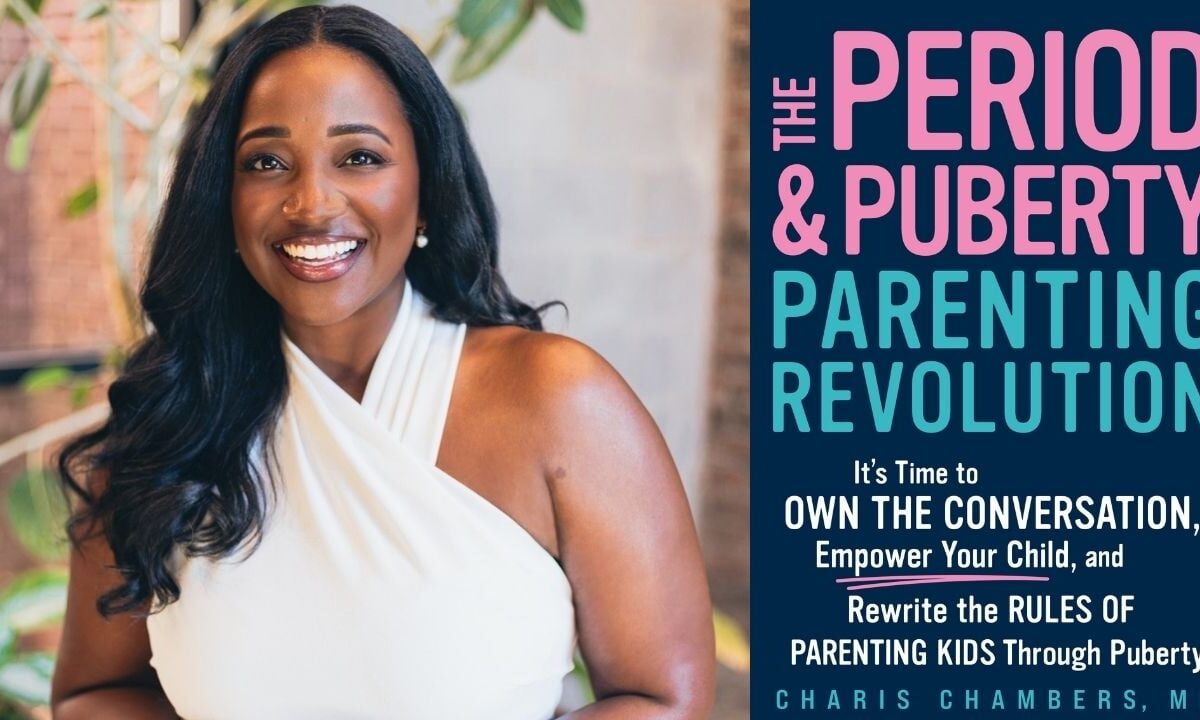
Dr. Charis Chambers wants Black families to stop treating puberty like a secret

In “The Period and Puberty Parenting Revolution,” Dr. Chambers shares why honest, age-appropriate conversations can help children build healthier relationships with their bodies.
Dr. Charis Chambers can recall a time in her Atlanta OB/GYN practice when a teen patient was afraid to ask basic questions about her growing and changing body.
The patient said things like “I want to talk to my mom about it, but every time I bring it up, she panics. Every time I ask her a question about tampons, she asks like I’ve done something wrong.”
“I’m just seeing how generational misconceptions and fears and stigma and all these things are negatively affecting even my encounter with the patient,” Chambers told theGrio over Zoom on Thursday. “I can’t even reach her to talk to her about her menstrual products and the ways to manage her periods because we’ve got all this shame in the room.”
It wasn’t a one-off occurrence. In her line of work, the board-certified OB/GYN and fellowship-trained pediatric and adolescent gynecologist says moments like these have become a major problem and even a barrier to care. Too often, the shame parents carry around their own bodies is being passed down to their children.
The OB/GYN, known as “The Period Doctor” to her growing online audience, delves into the topic in her new book, “The Period and Puberty Parenting Revolution.”
“I decided to write the book to fill in all the gaps with my medical knowledge, with my perspective, with my interest in being a young Black woman from the South, being someone who was raised in the Christian church, someone who navigated purity culture, and all of these same things that contributed to the stigma and shame that I had to unlearn,” she explained.
It’s Chambers’ hope that what she’s learned after witnessing these interactions over and over again—including why she believes they’re especially common in Black families and how those moments can shape children’s relationships with their bodies long after they leave the exam room—lands with parents, both mothers and fathers.
For generations, shame around our bodies and how they develop has come from a multitude of places, including religion. So much of how we understand reproductive health can be tied to religious ideals around purity, ideas that are then passed down and can create a legacy of silence around experiences that are actually natural biological processes, like menstruation.
“When you think about shame, there are so many sources,” she noted. “There’s the shame and stigma that is the result of like religious spaces.”
For Black women and girls specifically, Chambers says there’s another layer to contend with. Shame around natural bodily functions, including natural odors, has also grown out of white supremacist stereotypes that have long painted Black women as dirty or unclean. The author noted that Black women and girls are among the top consumers of products like feminine washes and wipes meant to mask those smells, even when some of those products may ultimately do more harm than good.
“There’s so much shame, especially in the Black community, that there’s something wrong with the way we navigate the world in a female body,” she continued. “So we don’t want to talk about having bad pain. We don’t want to talk about bleeding. We don’t want to talk about all of these other things.”
When adults can’t get past their own hang-ups and shame around these topics, children inherit them. Hiding period products or any mention of menstruation from the boys in the house doesn’t protect anyone. Instead, it can teach girls that something happening naturally to their bodies should be hidden, while leaving boys out of conversations that could help them better understand and have compassion for the girls and women around them.
“The general context is raising boys and men to be good humans and not having some gender qualifier on what they can show up in and how they can show up for people in their lives,” the doctor said.
She suggests parents take a simple approach and speak matter-of-factly about puberty and reproductive health, the same way they would if they got a paper cut and now need a bandaid or explain any other part of the world around their children. The doctor uses her own son as an example. Living in Atlanta, home to the busiest airport in the country, he’s inevitably going to see and hear big, loud planes flying overhead.
So, in a way he can understand, she explains that a plane is a mode of transportation that carries people from one place to another and is flown by a pilot. She doesn’t need to explain the complicated physics or engineering that makes the aircraft fly. She’s simply giving him enough information to understand the world he inhabits in a way that makes sense for his age. Puberty, she argues, doesn’t have to be any different.
Rather than shroud it in secrecy or wait until children become teenagers for one big, uncomfortable conversation, parents can normalize these topics in small ways throughout their everyday lives. That might sound as simple as, “Mommy has to change her pad,” or, “Your sister needs pain medicine because she has menstrual cramps.”
Without those conversations, Chambers warns, we risk raising girls who don’t understand what’s happening to their own bodies alongside boys who have never been given the tools to understand what the girls around them are experiencing. She noted how childbirth has evolved. There was a time when men weren’t allowed in delivery rooms as their wives and partners gave birth, leaving many with little understanding of what their partners had physically endured. As men began entering delivery rooms and attending prenatal appointments, they gained greater insight into pregnancy, childbirth, and the warning signs that can accompany both.
“There have been husbands who’ve saved their wives’ lives because they’ve been in that room because they knew what to look for because they are people who have voices who love the person involved,” she expressed.
Part of making these conversations easier also requires reconsidering what “age appropriate” actually means. Puberty is something children go through, Chambers reminded. It is, by definition, a topic for children.
Puberty can begin as early as 9 years old, and there are gentle, age-appropriate ways to explain that their bodies are going to change as they grow and that those changes aren’t wrong or shameful. They’re natural. Wet dreams are natural. Developing breasts is natural. Getting a period is natural. Developing crushes is natural. Children deserve to understand what’s happening to them, and they deserve safe adults they can turn to when they have questions about it.
Still, many parents fear that talking openly about puberty, periods, and reproductive health will somehow encourage children to become sexually active. Chambers says the opposite is true. However, there are many parents, fathers and mothers alike, who she said want to keep their children pure, asexual, and ultimately safe. But, somewhere along the way, the desire to protect children has become confused with keeping them in the dark, leaving too many to navigate their changing bodies and the questions that come with them on their own.
Chambers said when parents have transparent conversations about reproductive health, there are “Studies that show that [children are] more likely to use the right products. They’re more likely to address their pain, and they’re more likely to have self-confidence, higher self-esteem, and this thing called self-efficacy, which means I believe I can do the things I want to do.”
Opening up the floor to these conversations has been a large part of what propelled Chambers’ platform. She formally launched The Period Doctor online to reach even more patients with the information she realized so many children and parents were missing.
Answering a need has become something of a pattern for her. The daughter of an OB/GYN father—the same father who went viral for attending a book event in her stead and selling out—Chambers was drawn to women’s health while in school, recognizing the great need. Now, she’s preparing to launch her own practice alongside two fellow Spelman graduates who, like Chambers, are each daughters of physician fathers. The practice will be the first of its kind in Atlanta to specialize in offering child gynecology services, an effort Chambers hopes will put the people with the most at stake in these conversations at the heart of them: the children.
“The fullness of a person’s existence, a human existence, is one where there is autonomy, and there is agency, and there is preparation for what life is going to offer them,” Chambers said. “When you try to keep your child perfect and small and controlled, you are robbing them of all of those things that make their life full.”