
Black Music Has Always Been a Lifeline. Black Music Month Should Treat It Like One
Most of us have songs that live so deeply in our memory, we can recite the lyrics on command years after the last time we listened to them. When we hear those songs again, even decades later, we enter a form of sonic time travel; the lyrics naturally repopulate in our minds, as do specific feelings and memories, completely unbothered by the passage of time.
For me, this time travel happens when I hear Deniece Williams’ “Let’s Hear It For The Boys.” It brings me right back to carefree moments from childhood, the simple idea of unconditional love, and a momentary sanctuary of safety where my biological mother and I sang the song at the top of our lungs with wild abandon as we drove around my hometown with the windows rolled down.
My memories are heavier when I hear Whitney Houston’s “I Will Always Love You.” That song transports me to the kitchen table of my first foster home, where I listened to that song on repeat as I contemplated how I felt about my social worker asking my biological mother to terminate her parental rights. The song became my immediate lifeline, holding me through the heartbreaking realization that you can love someone deeply and still know you have to let them go.
For Black folks, our relationship with music runs far deeper than the nostalgia that captures the moments and memories we associate with each song in the soundtrack of our lives. Music has often been a way of finding, feeling, and connecting with our inner selves in a world that often works diligently to disorient and distract us from living, loving, and being fully free.
When that freedom feels out of reach in our lives, music holds the truth of where we are.
Early in my career, Nina Simone’s “Mississippi Goddam” became my anthem after a conversation with a mentor where I was forced to face the crushing truth that despite generations of incremental progress, the realities of American racism remained fundamentally unchanged and present enough to impose a glass ceiling on my career trajectory.
Every June, Black Music Month cycles us through artist spotlights, factoids, and curated playlists. While I’m a firm believer in paying homage to Black musical talent, what’s often overlooked is how Black music has been a vital artery in Black life and in the central nervous system binding Black people and culture.
Black music has been our motivation and salvation, a site of spiritual reckoning, a mirror for grief, and a purveyor of joy. It provides a testimony and bears witness to our emotions and inner worlds, capturing a depth of emotion that lies completely outside the scope of traditional sociology, history, and journalism, fields that are often tasked with documenting and capturing Black lives.
I’ve often described journalism as a window built around observation from a deliberate distance. Journalists are trained to get close enough to the story to report it accurately, yet far enough away to maintain a sense of neutrality and prevent ourselves from becoming the story. We are taught that neutrality is what makes the record credible, even factual. Sociology and history follow a similar principle. All three disciplines require observing and documenting conditions rather than fully inhabiting them.
Music works quite differently. It is nearly impossible to listen to Billie Holiday’s “Strange Fruit” and remain a neutral observer. The way Holiday sang with such haunting grief in her voice didn’t allow white audiences to maintain the comfortable distance of digesting racial terror through a carefully constructed news report as a point of record.
For Black folks, “Strange Fruit” captured our unedited pain through sound, a visceral reminder that the texture of notes and the raw timber of Holiday’s voice made music the only language with a vocabulary capable of holding a devastating trio of truths. This sonic record carries the unthinkable terror of the act of lynching itself, the fear-tinged anguish of unrelenting and devastating loss, and the debilitating gravity of our collective grief.
Nina Simone’s “Mississippi Goddam” captured the collective rage and exhaustion of a people pushed to our absolute limit by the specter of racism. She weaponized a jarring dissonance, using a deceptively upbeat cabaret rhythm to convey our unbridled fury about the elusiveness of justice. This frantic, driving tempo conveyed a deep impatience directed towards white people who preferred the fallacy of slow, comfortable progress to accountability and immediate progress.
The best journalism provides a window into flawless, unblemished truths as seen through a journalist’s eyes. It is easy to be moved but passive when you are reading or watching a news story that provokes feelings that make you question your morals and values, but that can be put off and doesn’t require you to take accountability or be part of moving solutions forward.
Nina Simone was compelled to write “Mississippi Goddam” in a rush of fury after hearing about the 16th Street Baptist church bombing that killed four young Black girls. For her, putting off questions and solutions was not an option. Simone understood the best music is a mirror through which the musician flexes their artistic license to intentionally create an emotionally provoking experience that reflects experiences, observations, inherited memories, and communal truths.
Hip hop pioneers Grandmaster Flash and the Furious Five also understood this and went a step further by making music that forced us to feel emotions while providing precise front-line reporting on the daily arithmetic of survival in an NY neighborhood plagued by systemic neglect, burning buildings, and municipal abandonment.
In “The Message,” they narrated conditions and conveyed the exhaustive entrapment of poverty with lines like, “Broken glass everywhere / People pissing on the stairs, you know they just don’t care / I can’t take the smell, can’t take the noise / Got no money to move out, I guess I got no choice.”
By anchoring the track in the famous refrain, “Don’t push me ’cause I’m close to the edge / I’m trying not to lose my head,” the song captured the psychological bind of feeling stuck and disempowered in an environment left to decay.
In many ways, Grandmaster Flash and The Furious Five were delivering raw data and a concrete answer to a question Marvin Gaye posed a decade earlier in his “What’s Going on?” as he soulfully pleaded to understand the fracturing of a nation that was juggling a brutal war in Vietnam and urban riots and police brutality at home.
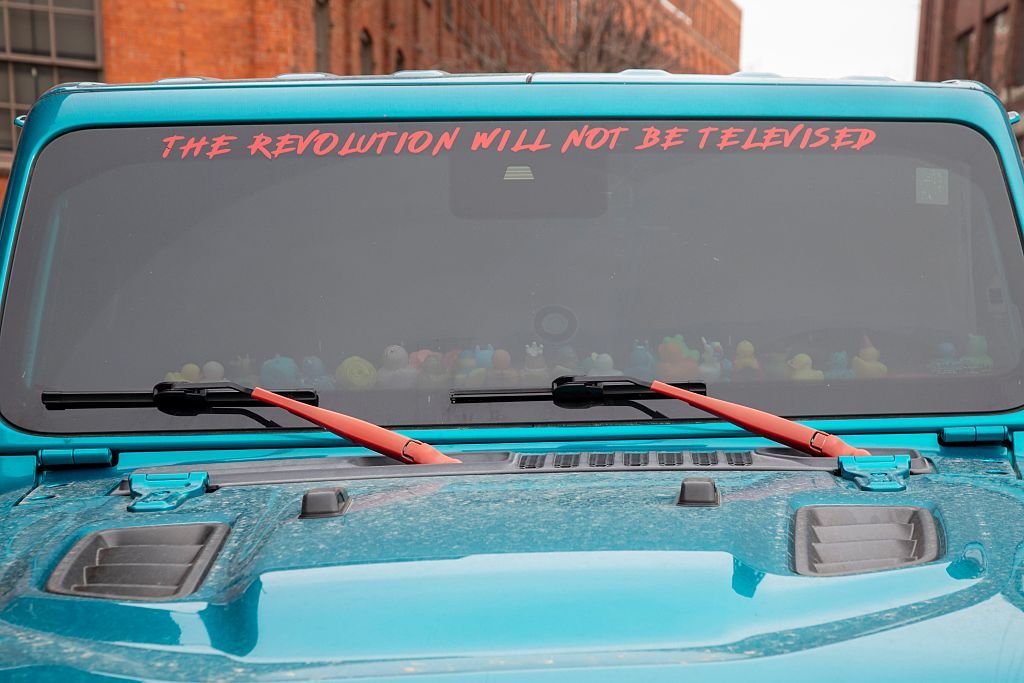
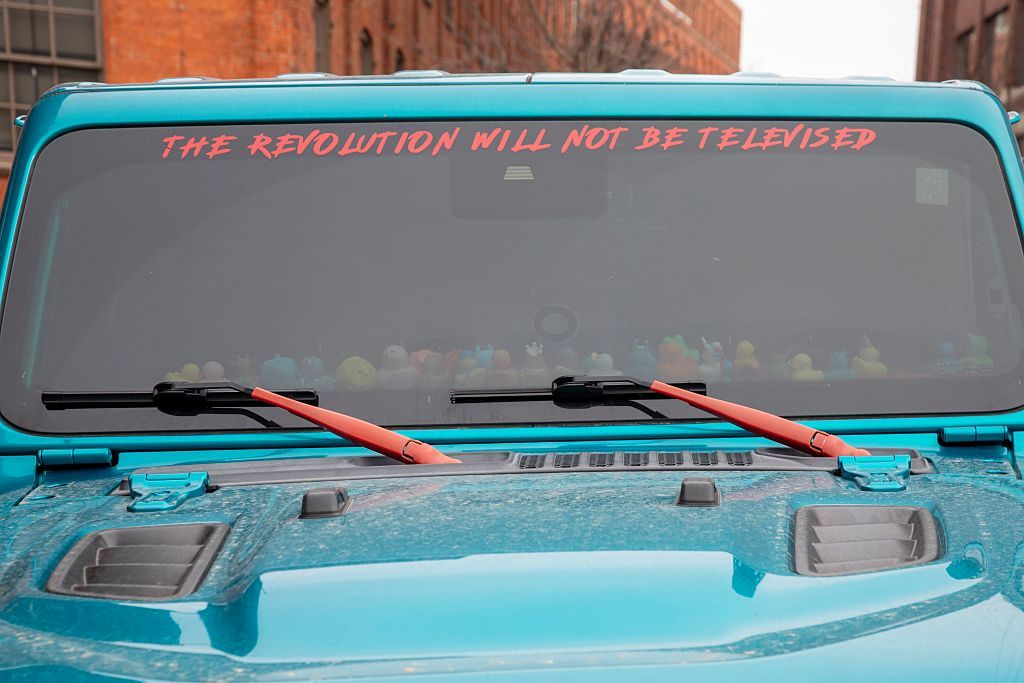
Gil Scott-Heron was among a smattering of artists who showed Black music can unlock what might be the ultimate weapon in the survival kit for Black folks: a brilliant, defiant imagination that transports us away from our material suffering and delivers us into a sharp, if not fantastical, unassailable clarity.
Heron narrowed the distance between an intergalactic moon landing and his overdue bills in his polemic “Whitey on the Moon.” Delivered over a syncopated conga rhythm, his biting sarcasm forced the listener to see that while the news was focused on white men using tax dollars to toil around on the moon, Black folks were trapped down on Earth, unable to afford basic necessities.
When Sam Cooke recorded “A Change is Gonna Come,” he steeled a resilient optimism by grounding change as the promised land and as an inevitability after a lengthy, hard-fought life. In his voice, you hear his grief, but also tendrils of a hopeful endurance that, if we just hang on, freedom will be ours. This unyielding belief has been rooted in and forged directly within the sanctuaries of Black church tradition, where unwavering faith has often emerged as a primary answer to unyielding discrimination, systemic barriers, and collective sorrow.
Aretha Franklin took the church’s call-and-response format and imbued gospel music tempos with urgency and intertwined them with the fiery political messaging of the Civil Rights movement. In her songs “Think” and “Respect,” Franklin brilliantly channeled her roots in the Black church, repurposing the traditional focus on divine faith into a direct demand for action and secular liberation. Franklin translated the spiritual expectation of freedom in the next life into a non-negotiable demand in this one. In her remake of Donny Hathaway’s “Someday We’ll All Be Free,” she gently vouched for freedom, reminding her listeners that it “won’t be long, take it from me, someday we’ll all be free.”
As the real world has struggled to provide true liberation to Black people everywhere, our music continues to reach toward hope and the fantastical, painting a picture of what Black liberation could look like. Stevie Wonder has emerged as one of the ultimate purveyors of hope through music, proving that pairing love and a brilliant imagination can be transcendent. Throughout his career, he has used his artistry to carve out a sweet sanctuary that refuses to let racism or systemic trauma have the final say.
Stevie even gave us a new way to sing “Happy Birthday” through his advocacy to recognize Martin Luther King Jr.’s birthday as a national holiday. Now his version is unapologetically ours, flipping aging into a celebration of endurance and reinforcing that surviving another year should earn us all a little extra razzle-dazzle before we blow out the candles on our birthday cake.
Stevie’s unyielding belief in our ability to thrive despite our oppression and our great capacity for love allowed him to step away from the human world entirely and deploy a form of magical realism to score the secret, interconnected consciousness of nature.
In his double album, “Journey through the Secret Life of Plants,” he uses synthesizers, bird calls, and lush instrumentation to translate the unseen life force found in Mother Nature into a universal language of love.
By finding a sacred cosmic connection in the smallest living things, he reminds us that the same divine life force binds us all together, anchoring our souls and our humanity as a pure, untouchable birthright.
Stevie proves to us that Black music shows us what we need to see and embrace about ourselves. That the music we create and consume contributes to the soundscape of Black life in America and is ultimately a celebration and testament to our humanity and our right to live, to breathe, and to find endless wonder in our brilliance, our beauty, and our joy.
SEE ALSO:
Nina Simone, Sam Cooke, And What Black Artists Sacrificed
Bigger Than The Music: Black Artists Speak Out Against Exploitation