
‘An Attempt … to Dismantle Our Power’: Supreme Court Leans In on Arguments Against Race-Based Redistricting In Louisiana Case That Could Further Gut the Voting Rights Act
While hearing oral argument over the racial makeup of voting districts in Louisiana on Wednesday, the justices comprising the conservative majority of the U.S. Supreme Court seemed inclined to undercut a key section of the landmark Voting Rights Act of 1965, enacted to prevent racial discrimination in voting.
Conservative Justice Brett Kavanaugh said during the hearing that “race-based remedies” put in place to address past discrimination should have an endpoint, and several other justices signaled their agreement.
If the Court rules that Section 2 of the Voting Rights Act (VRA), which bars voting maps that would result in diluting the voting power of minorities, is unconstitutional, that decision would have far-reaching effects nationwide on how congressional and other electoral districts are drawn, and ultimately how Black and other minority voters are represented.
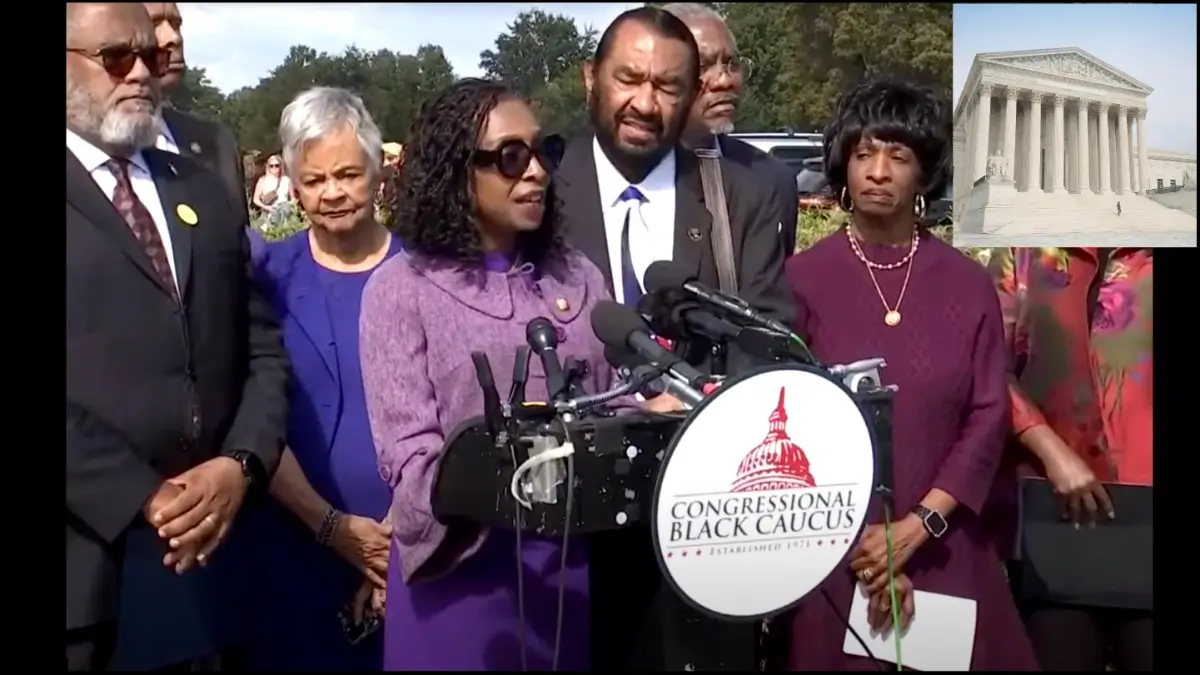
“This case threatens to dismantle one of the last remaining safeguards against racial discrimination in our electoral system, and the stakes could not be higher,” said Democratic Rep. Yvette Davis Clarke, the chair of the Congressional Black Caucus, during a gathering of Black lawmakers in Washington minutes after the hearing concluded.
“Republicans are attempting to run the table with every dirty trick in order to cement power because their policies have failed. Combined with Republicans’ mid-decade gerrymandering, a ruling gutting Section 2 could help them secure an additional 27 safe Republican House seats, at least 19 directly tied to the loss of Section 2,” the New York congresswoman said, echoing analysis from Fair Fight Action and Black Voters Matter.
In the case before the court, Louisiana v. Callais, the justices are examining whether the state’s latest congressional map, which includes a second majority-Black district, constitutes an unconstitutional racial gerrymander, as a group of plaintiffs describing themselves as “non-African American” claim.
The legal fight over voting rights in Louisiana erupted in 2022 when a group of Black voters sued the state, arguing that the 2020 Census showed that Black residents now made up about one-third of the state’s population and that the current map that included only one majority-Black district among six congressional districts was in violation of the VRA.
A federal court agreed and ordered the state legislature to draw a new map with a second majority-Black district (District 6) in 2024, which was quickly challenged by the mostly white voters in the Callais lawsuit as an unconstitutional racial gerrymander in violation of the 14th Amendment’s Equal Protection clause.
A lower court agreed and halted use of the map until the Supreme Court issued an emergency ruling that allowed Louisiana to use it for the 2024 elections, resulting in Cleo Fields, a Black Democrat, being elected in the new majority-Black Sixth District.
In August, the justices issued an order directing the litigants to file briefs addressing a broader legal question: “whether the State’s intentional creation of a second majority-minority district violates either the 14th Amendment or the 15th Amendment, which bars the government from denying or restricting voting rights based on race.
Now giving the Louisiana lawsuit its full attention in the current session, the Supreme Court, which has a 6-3 conservative majority, seems poised to weaken the provision of the VRA that allows lawmakers to consider race when drawing districts.
During Wednesday’s oral argument, several of the court’s conservative justices appeared focused on whether there should be a time limit on using race as a factor in creating electoral maps, a requirement that stemmed from 1960s-era protections aimed at undoing generations of efforts to suppress the power of Black voters, noted the New York Times.
“This court’s cases, in a variety of contexts, have said that race-based remedies are permissible for a period of time — sometimes for a long period of time, decades in some cases — but that they should not be indefinite, and should have an end point,” said Justice Kavanaugh, who voiced the same concerns two years ago when voting to uphold Alabama’s voting maps, which rely on the VRA’s current approach to using race as a factor in the creation of voter districts.
Chief Justice John Roberts, who previously called Louisiana’s new district, which stretches from Baton Rouge in southern Louisiana to Shreveport in the state’s northwest corner, a “snake,” seemed to question the idea that the Alabama decision should influence the court’s decision in Louisiana, CNN reported.
That prompted Justice Ketanji Brown Jackson to interject that the issue in the Alabama case was whether to change the way courts look at the Voting Rights Act in redistricting, “and we chose not to,” she said.
Still, Roberts, Kavanaugh and Justices Samuel Alito and Amy Coney Barrett seemed open to the arguments of Justice Department lawyer Hashim Mooppan, who said plaintiffs who bring a Section 2 claim should have to present a map that respects a range of race-neutral principles, including a desire by state legislators for partisan advantage, Reuters reported.
Since 2019, the Supreme Court has held that racial gerrymandering is unconstitutional, but claims of excessive partisan gerrymandering could not be challenged in federal court, encouraging state legislatures to carve up districts with partisan political ends in mind. Because party affiliation and race of voters are often strongly correlated, the majority party in control of redistricting can implement a racial gerrymander while claiming to be colorblind.
“White Democrats in West Virginia, they don’t get white districts drawn for them,” Mooppan said, noting that Section 2 requires that “you have to create a district for Black Democrats that you would never create for white Democrats in a Republican state. It’s essentially being used as a reverse partisan gerrymander on purely racial grounds. And that is a constitutional problem.”
Presenting a Trump administration idea, Mooppan suggested that the court could modify the test it uses to evaluate potential Voting Rights Act violations, to give states more leeway to justify maps on a state’s political objectives, an approach Kavanaugh called “a real innovation.”
Mooppan also told the justices that “there are roughly 60 Black representatives” in Congress right now, but “only 15 majority-Black districts.” “[N]one of these positions” advanced by the Trump administration or the other litigants opposing the 2024 map, he said, “is going to lead to there being no Black representation in Congress or anything remotely approaching that.”
But the court’s liberal justices pushed back, expressing deep concerns about eliminating race from the planning of voting maps, the Times observed.
Justice Elena Kagan asked Janai Nelson, the president of the NAACP Legal Defense Fund, what would happen if the key section of the VRA to prevent the dilution of minority votes were “to cease to operate.”
“I think the results would be pretty catastrophic,” Nelson responded. “We only have the diversity that we see across the South, for example, because of litigation that forced the creation of opportunity districts under the Voting Rights Act.”
Nelson told the justices that racially polarized voting is a reality and that it would be reckless to decide that Section 2 is unnecessary, reported Reuters. The map initially drawn by the Louisiana legislature had diluted Black voting power in order to hand the state’s white voters, who represent a majority of Louisiana’s population, “entrenched control,” she said.
In its written arguments, the state of Louisiana said, “There is no safe harbor for racial discrimination the government deems good discrimination. These violations of basic equal protection principles ended race-based admission programs. They should also end race-based redistricting.”
The fact that the claim by “self-described non-African American voters” that “the map intended to remedy racial discrimination is somehow discriminatory against them is being entertained by the highest court in the land is not only absurd but dangerous,” said Rep. Davis Clarke. “This is an affront to every community that has fought, marched and bled for the right to vote. … We will continue fighting in the courts, in the Congress and in our communities against any attempt to silence our voices and dismantle our power.”
“The Supreme Court must uphold the Voting Rights Act and the current fair, lawful congressional map that reflects the people of Louisiana,” said New Orleans Democrat Troy Carter, one of the state’s only two Black members of Congress, in a statement on Wednesday. “The stakes are nothing less than the future of representative democracy in our state and our nation. We must not allow the erosion of this promise — not now, not in Louisiana, not anywhere and not on our watch.”
The Supreme Court is expected to rule on the case next spring, but if it acts sooner, its decision could have an impact on congressional maps used for the 2026 midterm elections.